
SAVeD: Learning to Denoise Low-SNR Video for Improved Downstream Performance
Abstract
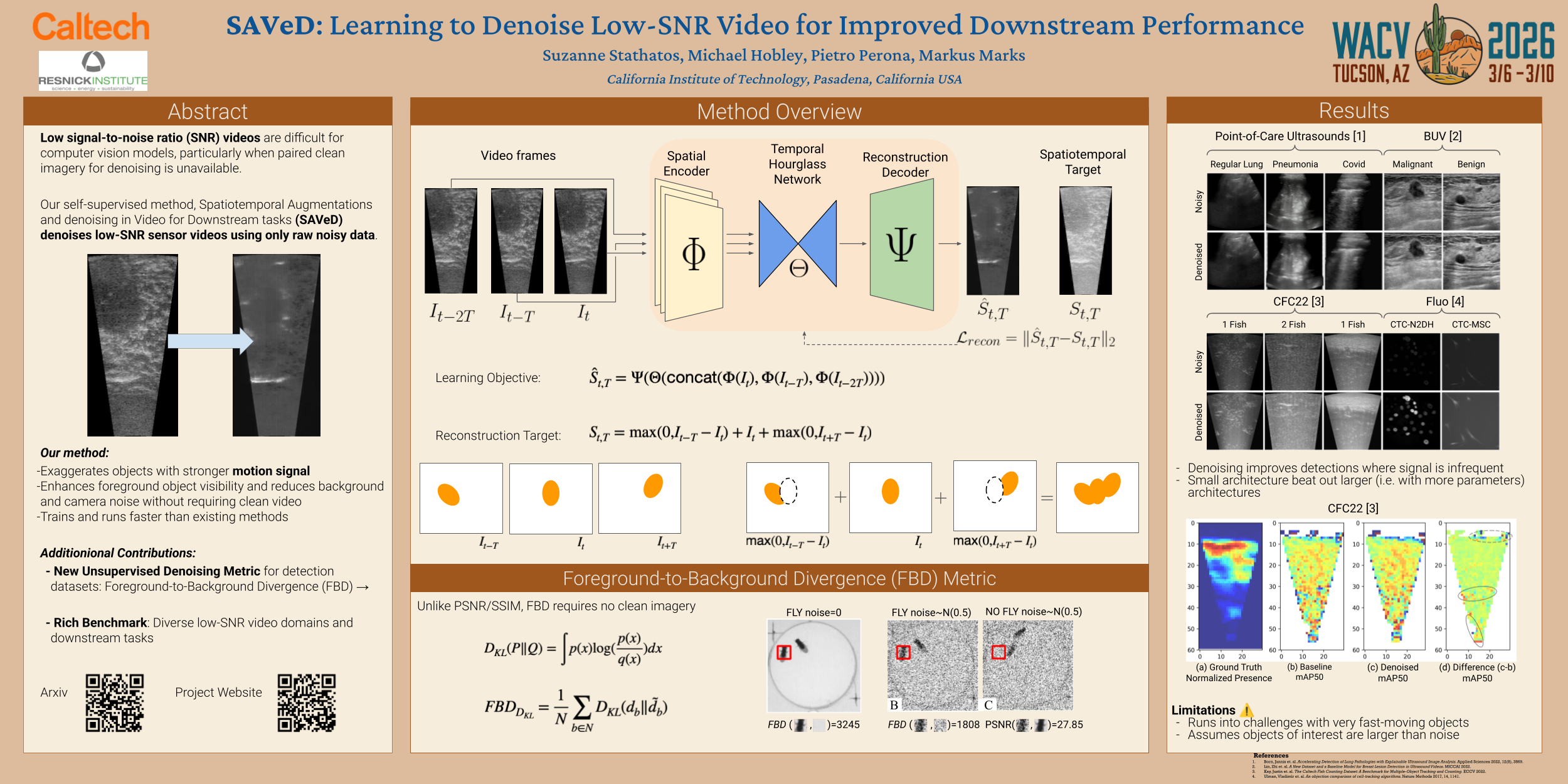
Low signal-to-noise ratio (SNR) videos—such as those from underwater sonar, ultrasound, and microscopy—pose a significant challenge for computer vision models, especially in the absence of paired clean imagery for denoising. We present Spatiotemporal Augmentations and denoising in Video for Downstream Tasks (SAVeD), a novel self-supervised method that denoises low-SNR sensor videos and is trained using only the raw noisy data. By leveraging distinctions between foreground and background motion and exaggerating objects with stronger motion signal, SAVeD enhances foreground object visibility and reduces background and camera noise while not requiring any clean video. SAVeD also has a set of architectural optimizations that lead to much faster throughput, training, and inference than existing deep learning methods. We also introduce a new denoising metric, FBD, which indicates foreground-background divergence without requiring clean imagery. Our approach achieves state-of-the-art results for classification, detection, tracking, and counting tasks and it does so with fewer training resource requirements than existing deep-learning-based denoising methods.