
GRAPE (Gaussian Rendering for Accelerated Pixel Enhancement) Brings Fast and Lightweight Arbitrary Super-Resolution
Abstract
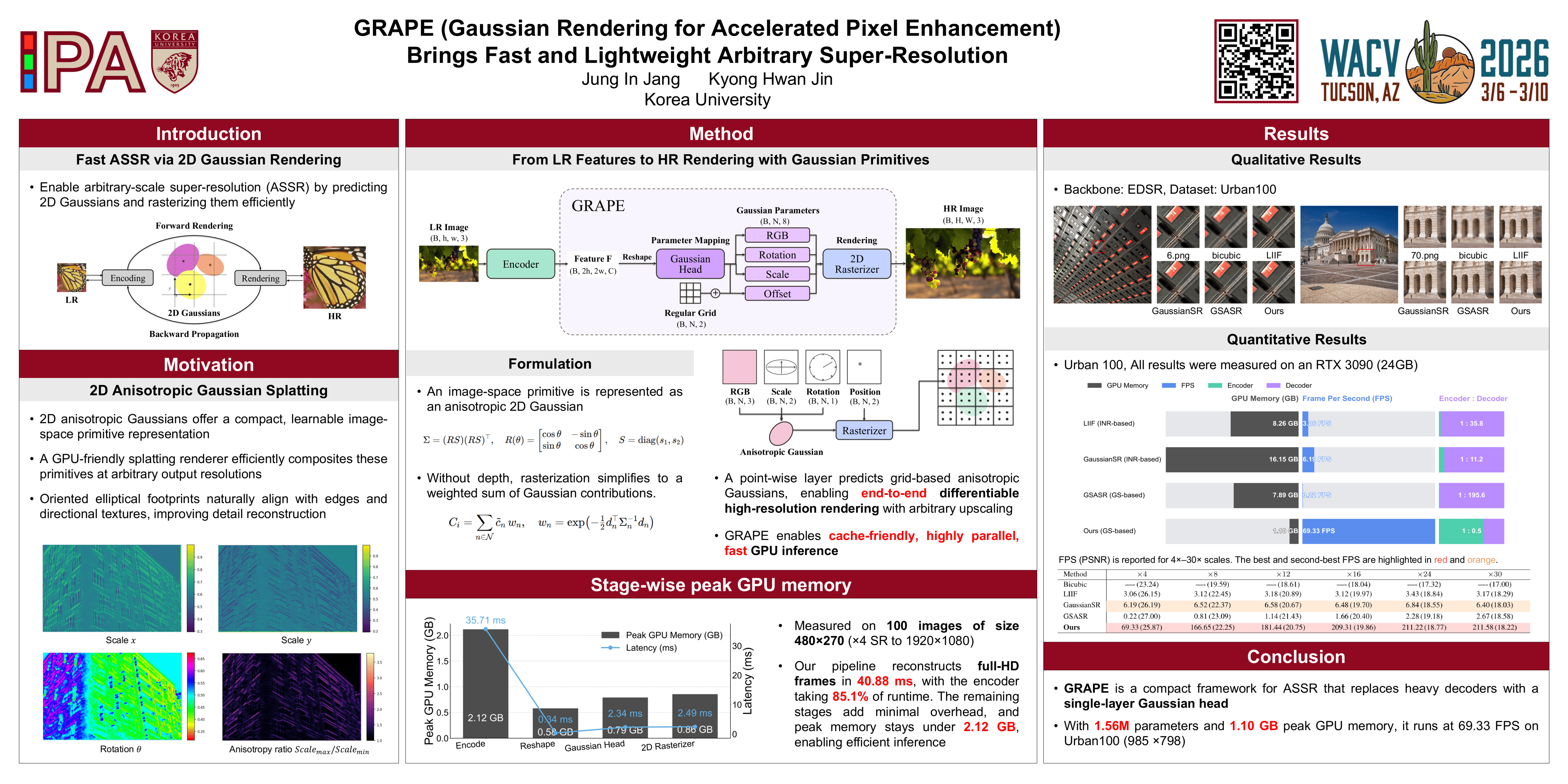
We present GRAPE-Gaussian Rendering for Accelerated Pixel Enhancement, a fast, lightweight method for arbitrary‑scale super‑resolution (ASSR) based on 2D Gaussian splatting. Lookup‑table (LUT) schemes are limited to preset scale factors and struggle with varied textures, while implicit neural representations (INRs) slow down because they require per‑coordinate queries; moreover, prior Gaussian‑splatting approaches rely on heavy networks or complex processing. GRAPE overcomes these limitations with a compact design in which a single point‑wise layer predicts anisotropic Gaussian parameters—RGB value, rotation, scale, and offset—and a differentiable rasterizer then renders the high‑resolution image in one pass. The entire model, including both encoder and decoder, contains just 1.56 M parameters and requires only 1.10 GB of GPU memory, yet achieves 68.55 FPS on Urban100 at x4 whose average image size is 984.51x797.81. This is more than 310x faster than GSASR, a 20.45 M‑parameter model that runs at 0.22 FPS. Although GRAPE does not further improve perceptual fidelity over heavier networks, it remains competitively close, providing an attractive quality–efficiency trade‑off across DIV2K, Set5, Set14, BSD100, and Urban100. Consequently, GRAPE is ideal for resource‑limited deployments or interactive applications that require rapid screen updates. The source code will be made publicly available at \href{https://github.com/username/GRAPE}.