
AGENet: Adaptive Edge-aware Geodesic Distance Learning for Few-Shot Medical Image Segmentation
Abstract
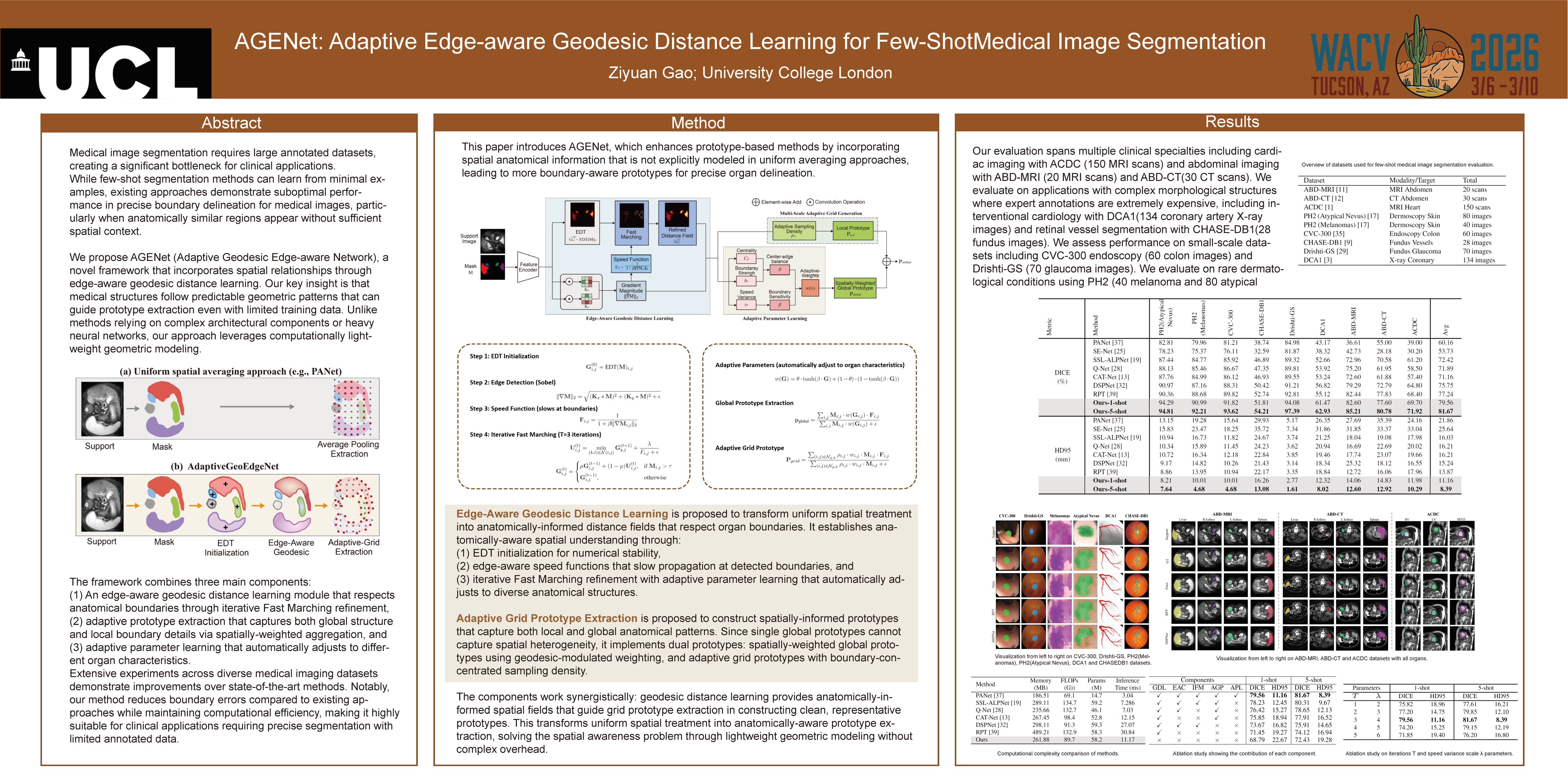
Medical image segmentation requires large annotated datasets, creating a significant bottleneck for clinical applications. While one-shot segmentation methods can learn from minimal examples, existing approaches struggle with precise boundary delineation in medical images, particularly when anatomically similar regions appear without sufficient spatial context. We propose GENet (GeoEdgeNet), a novel framework that incorporates spatial relationships through edge-aware geodesic distance learning. Our key insight is that medical structures follow predictable geometric patterns that can guide prototype extraction even with limited training data. Unlike methods relying on complex architectural components or heavy neural networks, our approach leverages computationally lightweight geometric modeling.The framework combines three main components: (1) A multi-component edge-aware geodesic distance learning module that respects anatomical boundaries, (2) adaptive prototype extraction that captures both global structure and local boundary details, and (3) a dual-mode optimization strategy that adapts to different organ types. Extensive experiments on AMOS and ACDC datasets demonstrate substantial improvements over state-of-the-art methods, achieving 82.60\% and 76.33\% mean Dice scores on ABD-MRI and ABD-CT respectively. Notably, our method reduces boundary errors by 44.5\% in terms of Hausdorff Distance compared to existing approaches, making it highly suitable for clinical applications requiring precise segmentation with limited annotated data.