
From Lightweight CNNs to SpikeNets: Benchmarking Accuracy–Energy Tradeoffs with Pruned Spiking SqueezeNet
Abstract
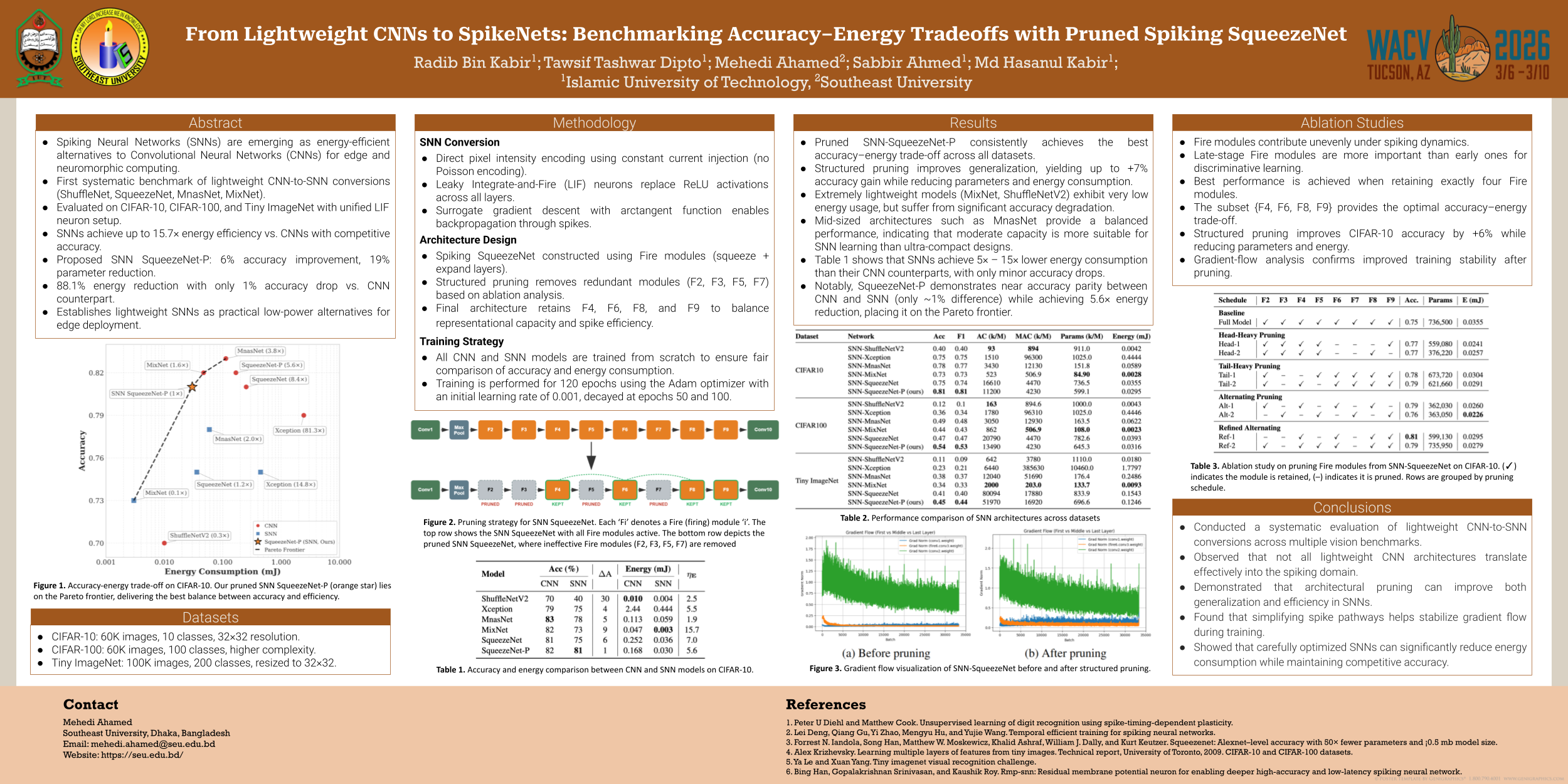
Spiking Neural Networks (SNNs) are increasingly studied as energy-efficient alternatives to Convolutional Neural Networks (CNNs), particularly for edge intelligence. However, prior work has largely emphasized large-scale models, leaving the design and evaluation of lightweight CNN-to-SNN pipelines underexplored. In this paper, we present the first systematic benchmark of lightweight SNNs obtained by converting compact CNN architectures into spiking networks, where activations are modeled with Leaky-Integrate-and-Fire (LIF) neurons and trained using surrogate gradient descent under a unified setup. We construct spiking variants of ShuffleNet, SqueezeNet, MnasNet, and MixNet, and evaluate them on CIFAR-10, CIFAR-100, and TinyImageNet, measuring accuracy, F1-score, parameter count, computational complexity, and energy consumption. Our results show that SNNs can achieve up to 15.7× higher energy efficiency than their CNN counterparts while retaining competitive accuracy. Among these, the SNN variant of SqueezeNet consistently outperforms other lightweight SNNs. To further optimize this model, we apply a structured pruning strategy that removes entire redundant fire modules, yielding a pruned architecture, SNN SqueezeNet-P. This pruned model improves CIFAR-10 accuracy by 6% and reduces parameters by 19% compared to the original SNN SqueezeNet. Crucially, it narrows the gap with CNN SqueezeNet, achieving nearly the same accuracy (only 1% lower) but with an 88.1% reduction in energy consumption due to sparse spike-driven computations. Together, these findings establish lightweight SNNs as practical, low-power alternatives for edge deployment, highlighting a viable path toward deploying high-performance, low-power intelligence on the edge.