
Remote Sensing Forestry Similarity Convolution
Abstract
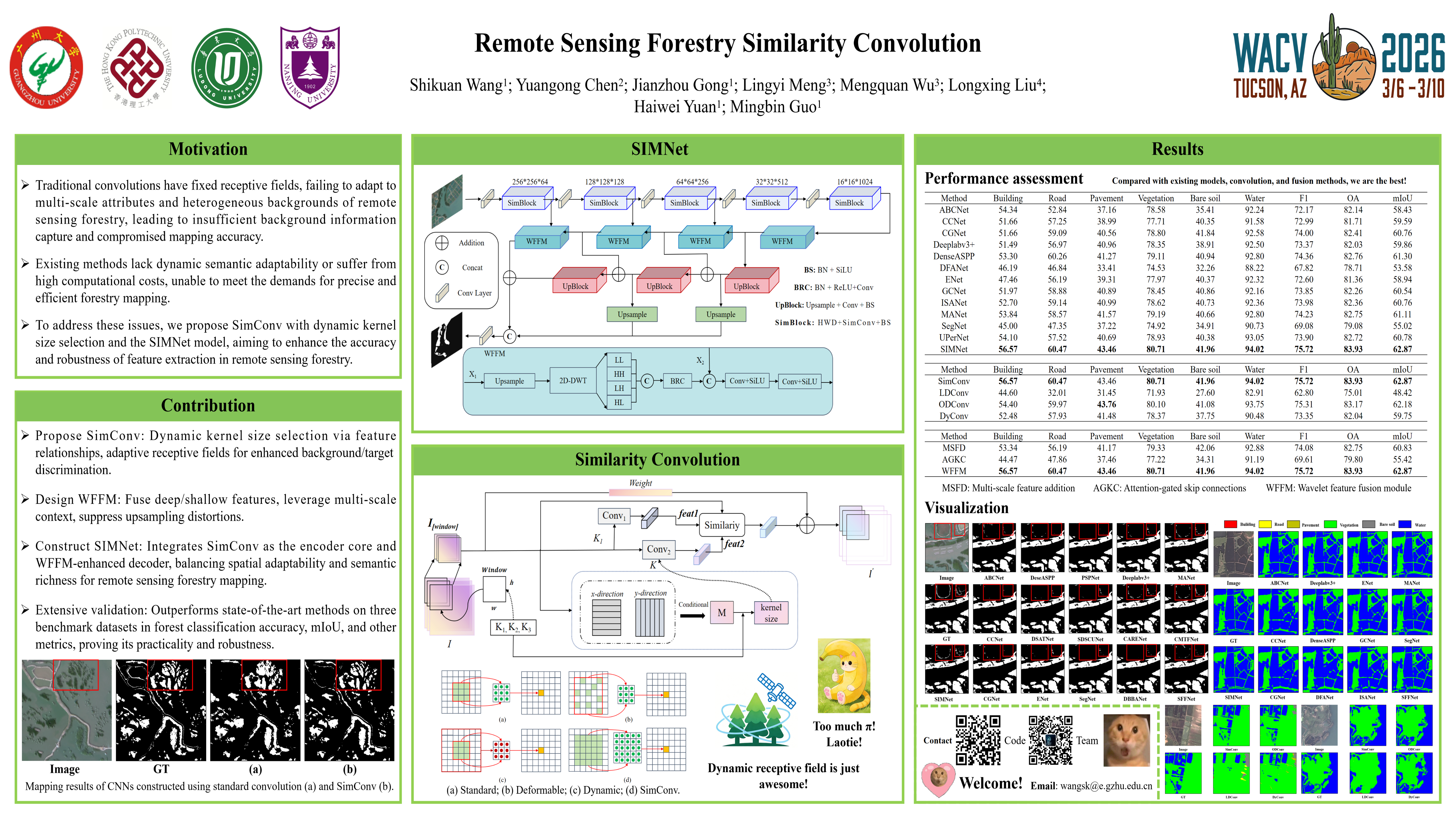
Recent advancements in convolutional neural networks (CNNs) have significantly propelled the field of remote sensing forestry mapping. However, traditional convolution operations exhibit inherent limitations in extracting complex forest features: their fixed receptive fields struggle to accommodate multi-scale forest attributes, and their insufficient focus on background information impairs the overall feature representation. To address these challenges, we propose Similar Convolution (SimConv), which introduces dynamic convolution kernel size selection by modeling feature relationships. SimConv adaptively adjusts the receptive field based on the semantic relevance of input features, enhancing the capture of forestry background information and improving the distinction between target features. Building upon this, we introduce SIMNet, a feature extraction network that integrates SimConv at its core. Experimental results across multiple remote sensing datasets demonstrate that SIMNet outperforms existing methods in terms of feature extraction accuracy.