
SCATR: Mitigating New Instance Suppression in LiDAR-based Tracking-by-Attention via Second Chance Assignment and Track Query Dropout
Abstract
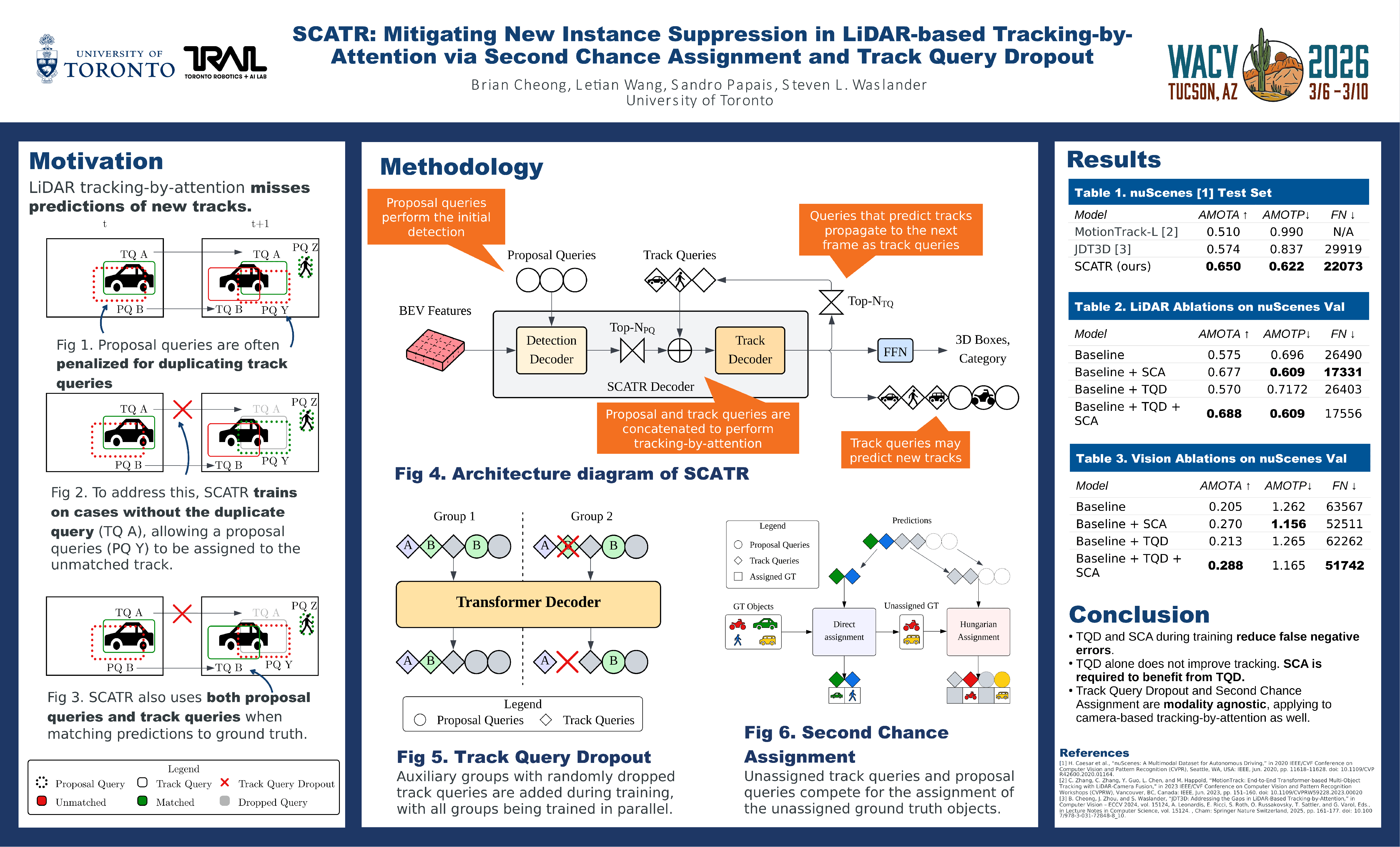
LiDAR-based tracking-by-attention (TBA) frameworks inherently suffer from high false negative errors, leading to a significant performance gap compared to traditional LiDAR tracking-by-detection (TBD) methods. This paper introduces SCATR, a novel LiDAR-based TBA model designed to address this fundamental challenge systematically. SCATR leverages recent progress in vision-based tracking and incorporates targeted training strategies specifically adapted for LiDAR. Our work's core innovations are two architecture-agnostic training strategies for TBA methods: Second Chance Assignment and Track Query Dropout. Second Chance Assignment is a novel ground truth assignment that concatenates unassigned track queries to the proposal queries before bipartite matching, giving these track queries a second chance to be assigned to a ground truth object and effectively mitigating the conflict between detection and tracking tasks inherent in tracking-by-attention. Track Query Dropout is a training method that diversifies supervised object query configurations to efficiently train the decoder to handle different track query sets, enhancing robustness to missing or newborn tracks. Experiments on the nuScenes tracking benchmark demonstrate that SCATR achieves state-of-the-art performance among LiDAR TBA methods, outperforming previous works by 7.6\% AMOTA and successfully bridging the long-standing performance gap between LiDAR-based TBA and TBD methods. Ablation studies further validate the individual and combined effectiveness of Second Chance Assignment and Track Query Dropout, highlighting their combined impact on improving tracking performance. Anonymized code can be found at the following link: \href{https://anonymous.4open.science/r/scatr-anon-C54A/}{https://anonymous.4open.science/r/scatr-anon-C54A/}