
One Model, Many Behaviors: Training-Induced Effects on Out-of-Distribution Detection
Abstract
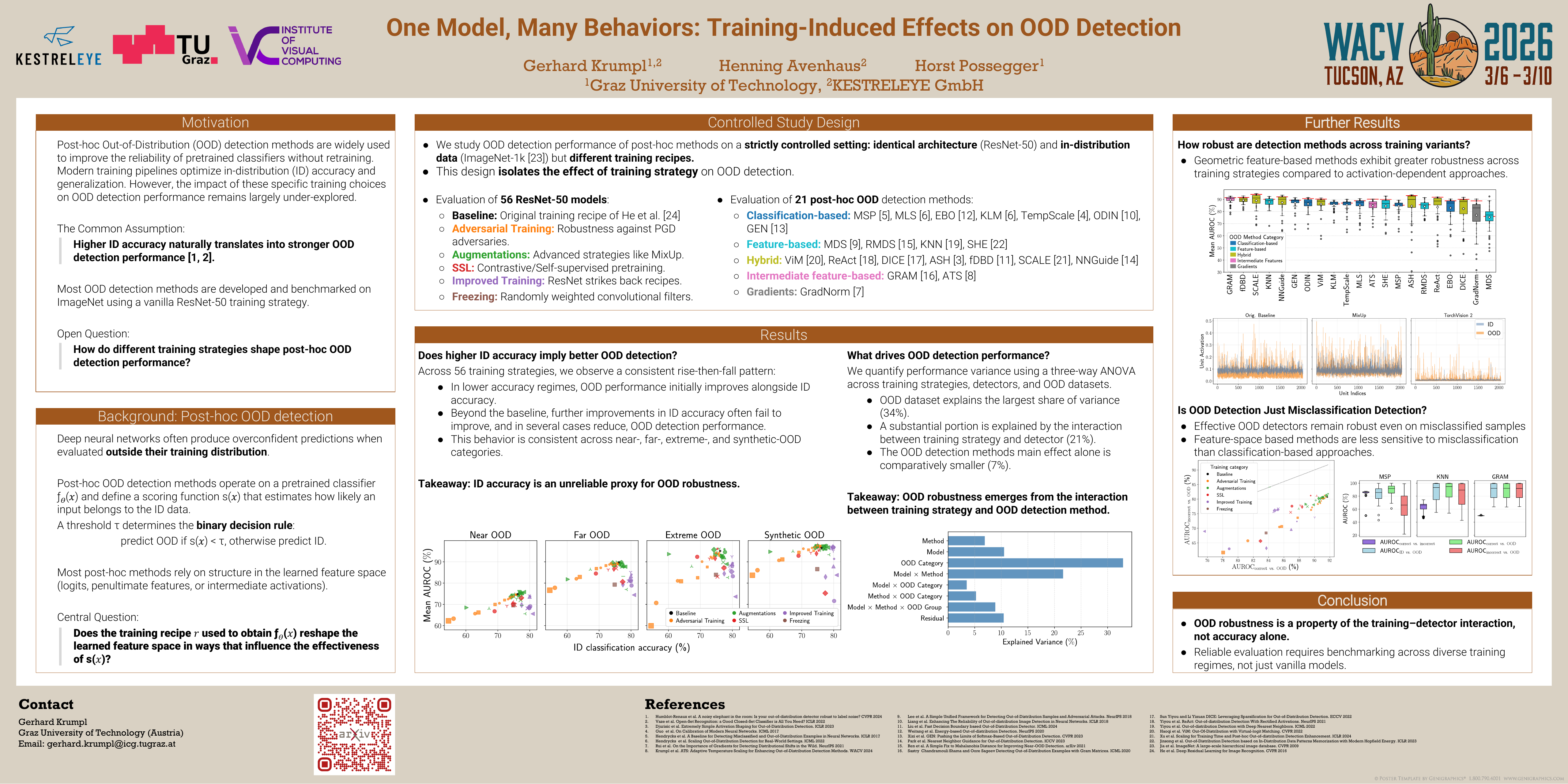
Out-of-distribution (OOD) detection is crucial for deploying robust and reliable machine-learning systems in open-world settings. Despite steady advances in OOD detectors, their interplay with modern training pipelines that maximize in‑distribution (ID) accuracy and generalization remains under-explored.We investigate this link through a comprehensive empirical study.Fixing the architecture to the widely adopted ResNet‑50, we benchmark 21 post-hoc, state-of-the-art OOD detection methods across 54 ImageNet-trained models obtained via diverse training strategies and evaluate them on eight OOD test sets.Contrary to the common assumption that higher ID accuracy implies better OOD detection performance, we uncover a non‑monotonic relationship: OOD performance initially improves with accuracy but declines once advanced training recipes push accuracy beyond the baseline.Moreover, we observe a strong interdependence between training strategy, detector choice, and resulting OOD performance, indicating that no single method is universally optimal.