
PEaRL: Pathway-Enhanced Representation Learning for Gene and Pathway Expression Prediction from Histology
Abstract
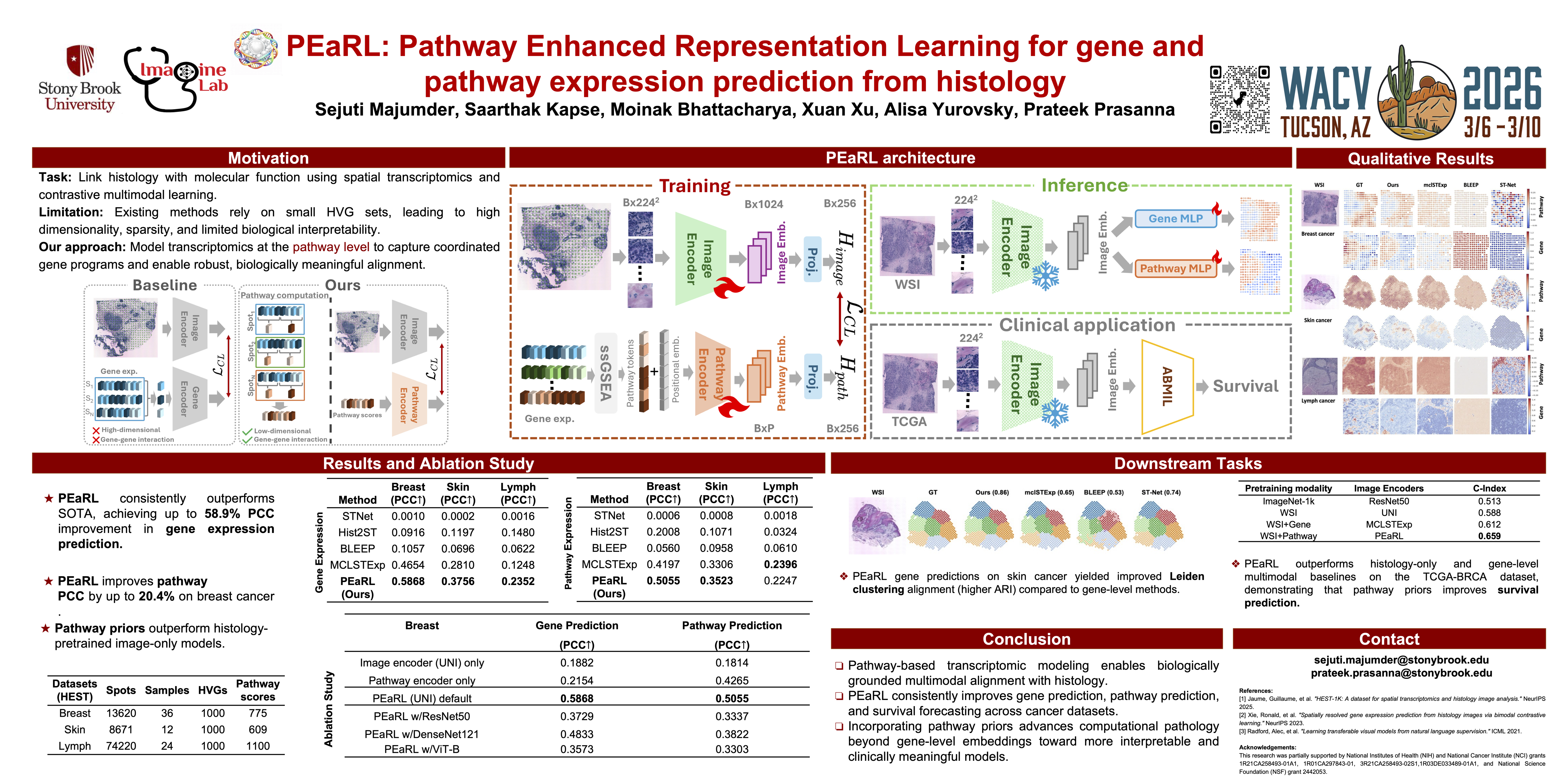
Integrating histopathology with spatial transcriptomics (ST) provides a powerful opportunity to link tissue morphology with molecular function. Yet most existing multimodal approaches rely on a small set of highly variable genes, which limits predictive scope and overlooks the coordinated biological programs that shape tissue phenotypes. We present PEaRL (Pathway Enhanced Representation Learning), a multimodal framework that represents transcriptomics through pathway activation scores computed with ssGSEA. By encoding biologically coherent pathway signals with a transformer and aligning them with histology features via contrastive learning, PEaRL reduces dimensionality, improves interpretability, and strengthens cross-modal correspondence. Across three cancer ST datasets—breast, skin, and lymph node—PEaRL consistently outperforms state-of-the-art methods, yielding higher accuracy for both gene- and pathway-level expression prediction (up to 58.9% and 20.4% increase in Pearson correlation coefficient compared to SOTA). These results demonstrate that grounding transcriptomic representation in pathways produces more biologically faithful and interpretable multimodal models, advancing computational pathology beyond gene-level embeddings.