
F-INR: Functional Tensor Decomposition for Implicit Neural Representations
Sai Karthikeya Vemuri ⋅ Tim Büchner ⋅ Joachim Denzler
Abstract
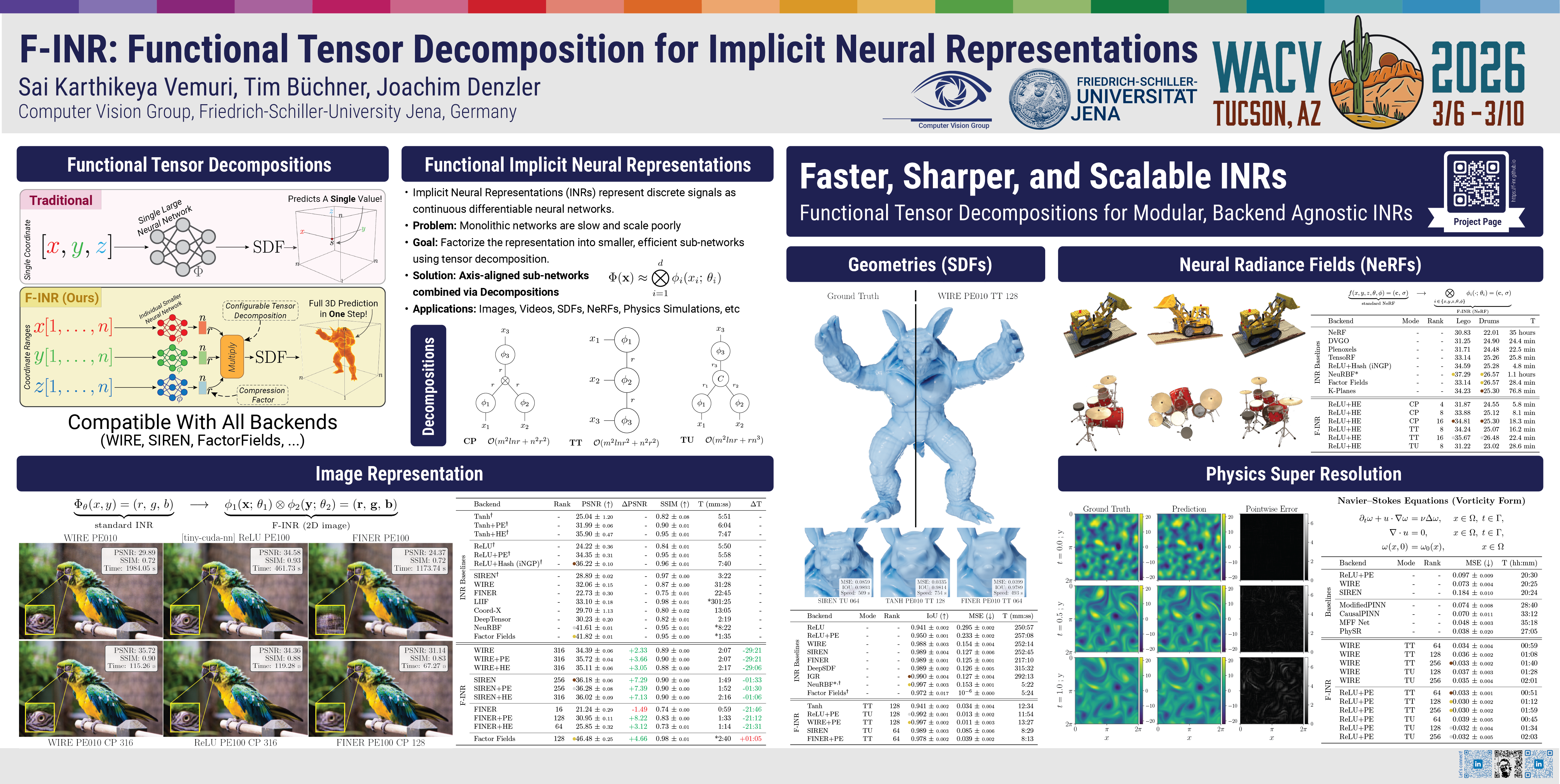
Implicit Neural Representations (INRs) model signals as continuous, differentiable functions.However, monolithic INRs scale poorly with data dimensionality, leading to excessive training costs.We propose F-INR, a framework that addresses this limitation by factorizing a high-dimensional INR into a set of compact, axis-specific sub-networks based on functional tensor decomposition.These sub-networks learn low-dimensional functional components that are then combined via tensor operations.This factorization reduces computational complexity while additionally improving representational capacity.F-INR is both architecture- and decomposition-agnostic.It integrates with various existing INR backbones (e.g., SIREN, WIRE, FINER, Factor Fields) and tensor formats (e.g., CP, TT, Tucker), offering fine-grained control over the speed-accuracy trade-off via the tensor rank and mode.Our experiments show F-INR accelerates training by up to $20\times$ and improves fidelity by over 6.0 dB PSNR compared to state-of-the-art INRs.We validate these gains on diverse tasks, including image representation, 3D geometry reconstruction, and neural radiance fields.We further show F-INR's applicability to scientific computing by modeling complex physics simulations. Thus, F-INR provides a scalable, flexible, and efficient framework for high-dimensional signal modeling.
Chat is not available.
Successful Page Load