
BanglaProtha: Evaluating Vision Language Models in Underrepresented Long-tail Cultural Contexts
Abstract
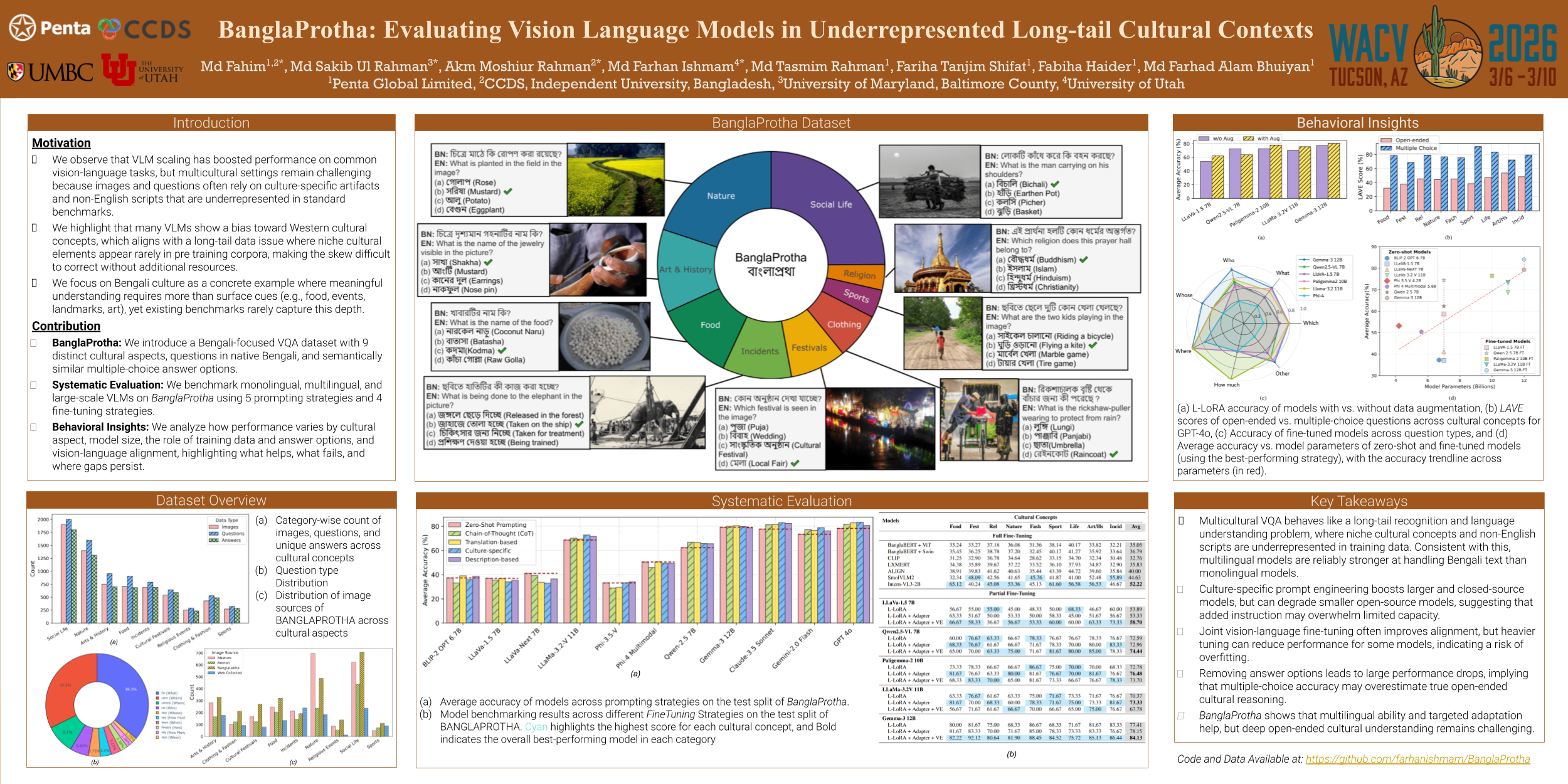
The advanced multimodal processing of current vision language models (VLMs) has prompted rigorous benchmarking in multicultural settings, revealing a clear inclination toward Western culture. While the bias likely stems from the predominance of Western-centric images in the VLM pretraining data, the resulting long-tail distribution problem is only exacerbated in underrepresented cultural settings, such as Bengali. Our work explores this problem through an aspect-based evaluation of several classes of VLMs on the rich Bengali culture. Our BanglaProtha dataset is a VQA dataset, containing images that encapsulate Bengali cultural elements, questions in native Bengali, and semantically similar multiple-choice answer options. Our experiments provide behavioral insights of VLMs across prompting & fine-tuning strategies, cultural aspects, model size, and augmentation methods. Our work serves as a diagnostic tool for addressing and mitigating inequalities in multicultural and multilingual settings, thereby bringing efforts to democratize AI systems.