
SafeguardGS: 3D Gaussian Primitive Pruning While Avoiding Catastrophic Scene Destruction
Yongjae Lee ⋅ Zhaoliang Zhang ⋅ Deliang Fan
2026 Poster
Abstract
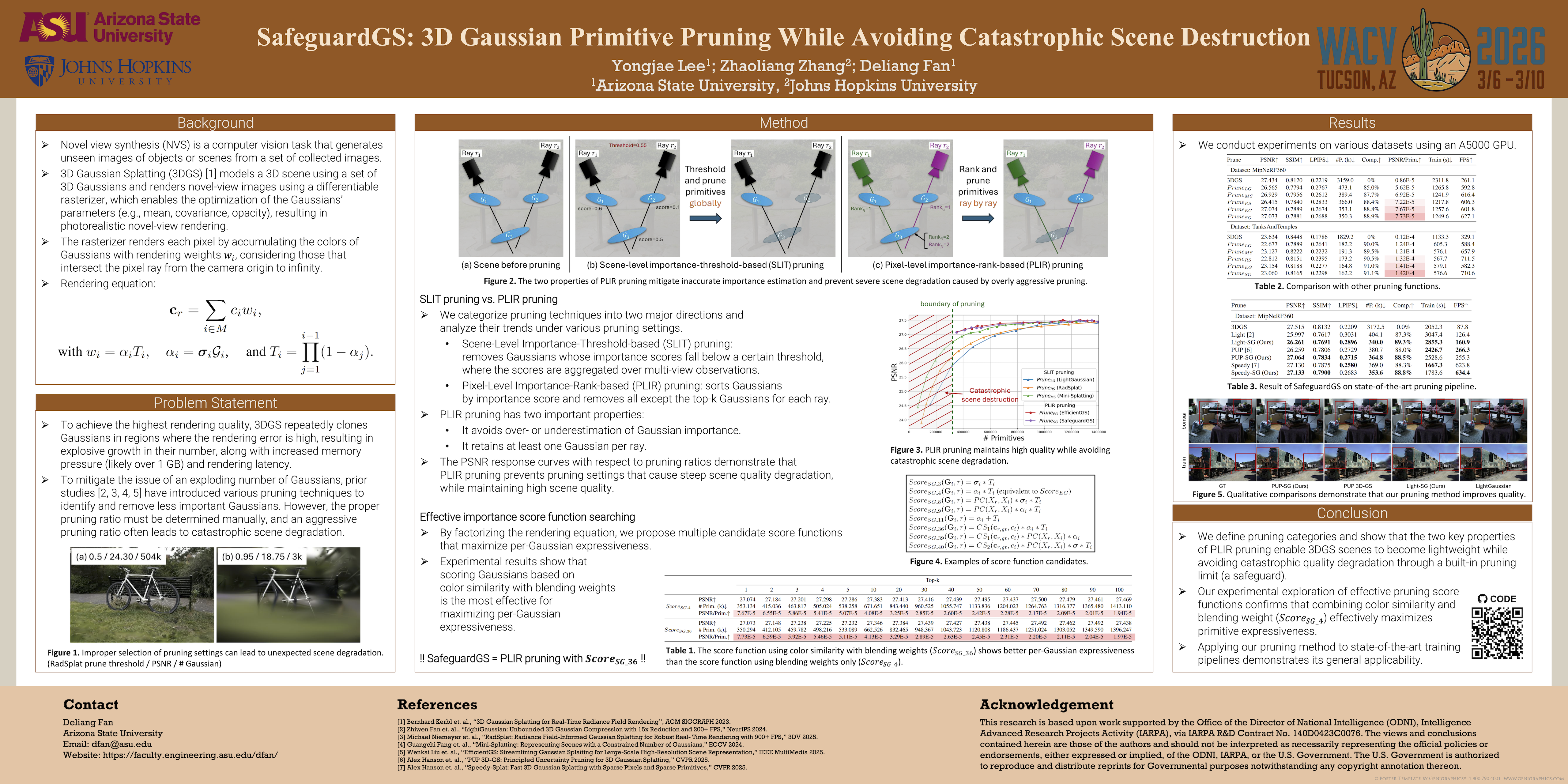
3D Gaussian Splatting (3DGS) has advanced novel view synthesis, but its densification process leads to an excessive number of Gaussian primitives, which negatively impact rendering speed and memory usage. Although many 3DGS pruning techniques have been proposed to address this issue, a comprehensive analysis is still lacking. In this paper, we are the first to categorize 3DGS pruning techniques into two approaches: scene-level importance-threshold-based pruning and pixel-level importance-rank-based pruning, defined by their scope of importance calculation (scene-level vs. pixel-level) and their pruning criteria (threshold vs. rank). Our studies reveal that while the former leads to disastrous quality drops under extreme Gaussian primitive decimation, the latter not only sustains high rendering quality but also provides a natural pruning boundary, i.e., a safeguard for Gaussian pruning. We further propose multiple pruning score functions. From our extensive studies on various pruning score functions, we discover that color similarity with blending weight is the most effective factor for identifying insignificant primitives. In our experiments, our proposed method, SafeguardGS, with the optimal score function achieves the highest PSNR-per-primitive performance under extreme pruning setting, retaining only about 10% of the primitives from the original 3DGS scene, i.e., $10\times$ compression ratio.
Chat is not available.
Successful Page Load