
Language Integration in Fine-Tuning Multimodal Large Language Models for Image-Based Regression
Abstract
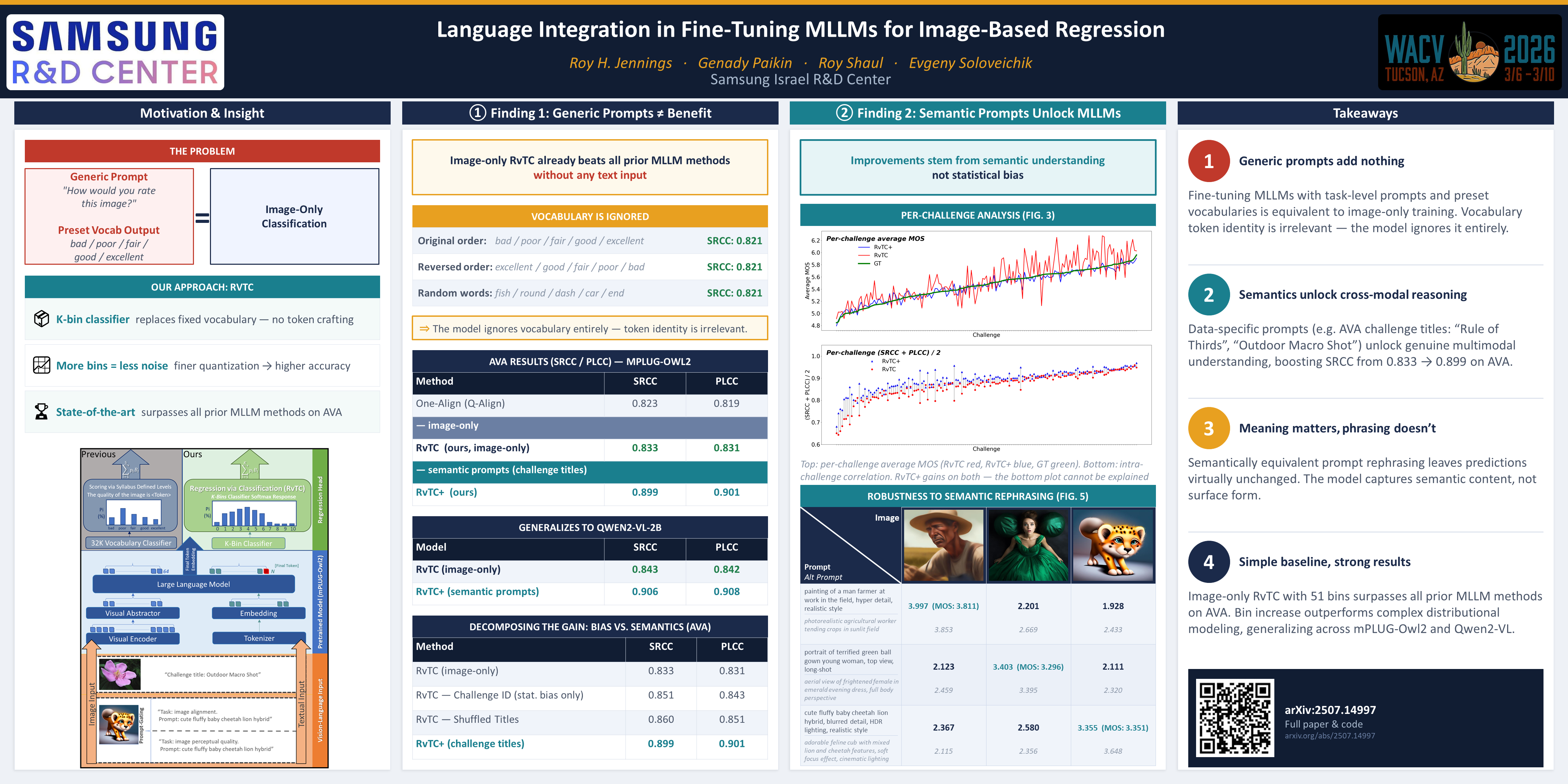
Multimodal Large Language Models (MLLMs) show promise for image-based regression tasks, but current approaches face key limitations. Recent methods fine-tune MLLMs using preset output vocabularies and generic task-level prompts (e.g., "How would you rate this image?"), assuming this mimics human rating behavior.Our analysis reveals these approaches provide no benefit over image-only training. Models using preset vocabularies and generic prompts perform equivalently to image-only models, failing to leverage semantic understanding from textual input.We propose Regression via Transformer-Based Classification (RvTC), which replaces vocabulary-constrained classification with a flexible bin-based approach.Unlike approaches that address discretization errors through complex distributional modeling, RvTC eliminates manual vocabulary crafting through straightforward bin increase, achieving state-of-the-art performance on four image assessment datasets using only images.More importantly, we demonstrate that data-specific prompts dramatically improve performance. Unlike generic task descriptions, prompts containing semantic information about specific images enable MLLMs to leverage cross-modal understanding. On the AVA dataset, adding challenge titles to prompts improves correlations from 0.83 to 0.90, a new state-of-the-art. We demonstrate through empirical evidence from the AVA and AGIQA-3k datasets that MLLMs benefit from semantic prompt information surpassing mere statistical biases. This underscores the importance of incorporating meaningful textual context in multimodal regression tasks.