
FlowMorph: Revealing an Optimizable Flow Latent Space for Controlled Image Morphing
Abstract
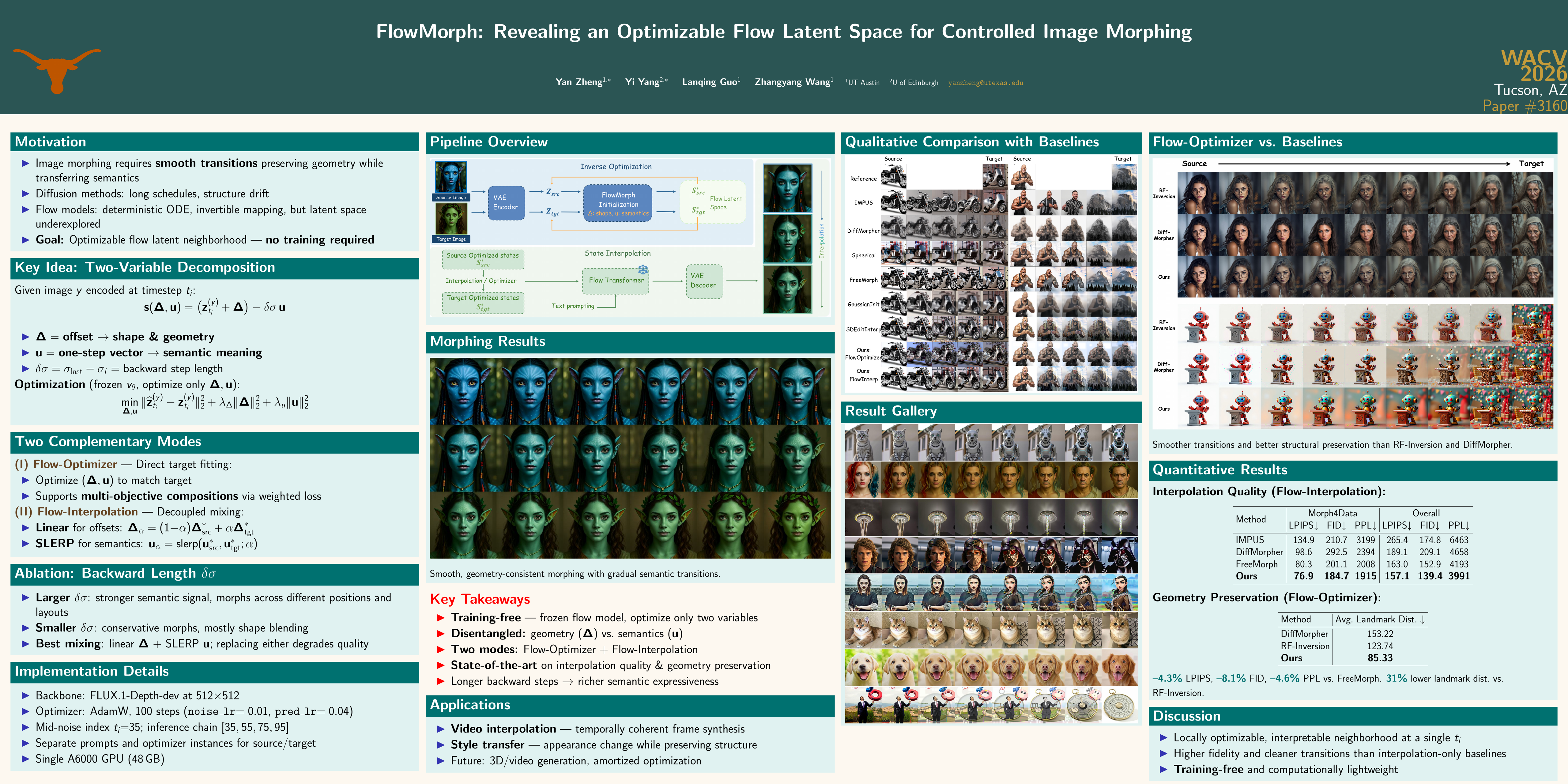
We present FlowMorph, a simple and training-free framework for geometry-preserving and semantics-aware image interpolation. The key idea is to separate two factors inside the flow model’s latent space: an offset that captures shape and geometry, and a one-step vector that carries semantic meaning. By keeping the flow model frozen and only optimizing these two variables, FlowMorph exposes a stable and interpretable neighborhood around each image. This leads to two complementary modes. Flow-Optimizer directly fits a source image toward a target image and naturally supports multi-objective combinations, producing stable reconstructions. Flow-Interpolation mixes the offset linearly and the semantic vector spherically, generating smooth and coherent transitions between images. Across a wide range of tasks including object morphing, pose changes, and scene transitions, FlowMorph outperforms prior interpolation-based methods. Quantitative experiments show that our method achieves lower perceptual error, better image fidelity, and smoother transitions. Landmark-based analysis further confirms that FlowMorph preserves geometry more effectively. We also ablate the effect of the backward step size, showing that longer steps increase semantic expressiveness and allow interpolations that move beyond trivial shape blending, enabling richer morphs across object positions and photo layouts. FlowMorph provides an interpretable and controllable tool for high-quality image morphing without the need for additional training.