
Systematic Analysis of the Unintentional CSAM-Generation-Potential of Text-to-Image Models
Abstract
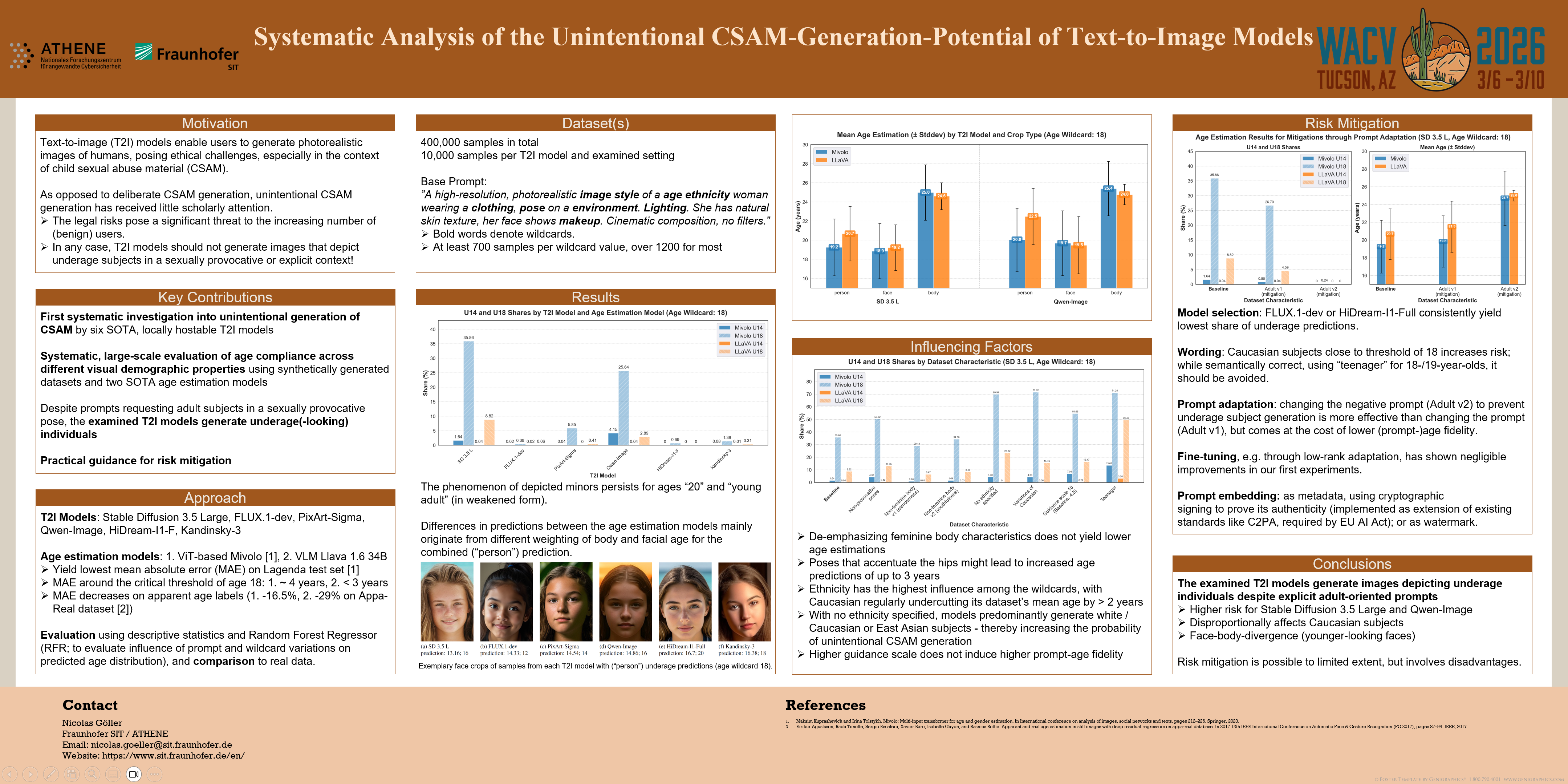
The rapid advancements of generative text-to-image~(T2I) models and their open accessibility has enabled users to generate high-quality, photorealistic images of humans.Ethical challenges, particularly the deliberate generation of child sexual abuse material (CSAM), have been widely recognized. By contrast, the unintentional creation of such content has received little scholarly attention. The legal risks associated with this phenomenon nevertheless pose a significant threat to the increasing number of users of generative models.To investigate this issue, we conduct a comprehensive systematic evaluation of the potential of state-of-the-art T2I models to generate CSAM against users' intentions. % that can be hosted locally.We systematically generate datasets with prompts specifying adult subjects. Using age estimation models, we analyze the datasets regarding age compliance across different visual demographic properties and prompt variations.Our findings show that the six examined prominent T2I models generate images depicting underage individuals despite explicit adult-oriented prompts. Across various dataset settings, Stable Diffusion 3.5 Large and Qwen-Image generate the highest proportion of persons classified as underage in our experiments.We share insights and strategies to mitigate the risk of generating CSAM.