
BAFIS: Dataset + Framework to assess occupational Bias and Human Preference in modern Text-to-image Models
Abstract
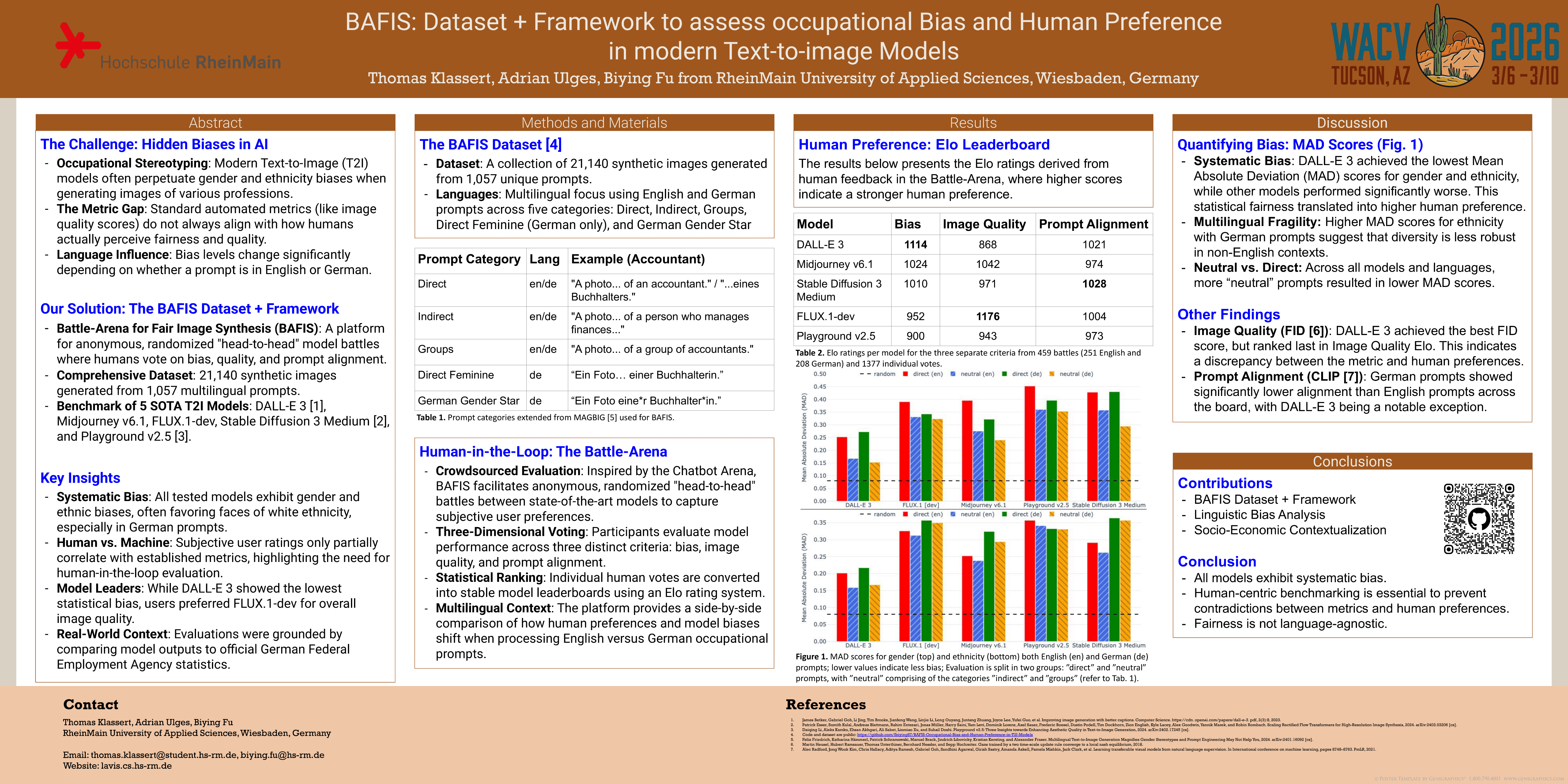
Generative artificial intelligence has the potential to improve productivity and transform the production of creative content. However, existing research indicates that image generation models are significantly influenced by biases. This work investigates the inherent biases and language-induced biases present in text-to-image models within the context of occupation-related image generation, complementing established metrics with human preference feedback. We present a comprehensive evaluation of five current text-to-image models: Midjourney v6.1, Stable Diffusion 3 Medium, DALL-E 3, Playground v2.5, and FLUX.1-dev , focusing on gender and ethnicity bias, image quality, and prompt alignment. To facilitate this evaluation, we developed the "Battle-Arena for Fair Image Synthesis" (BAFIS), a platform designed to collect human feedback on bias in generated images. Furthermore, we created a dataset comprising 21,140 synthetic images generated using multilingual prompts, which serves as a basis for our analysis. We further place our results within a broader social context by comparing them to official statistics from the German Federal Employment Agency. Our findings reveal systematic biases in text-to-image models, with established evaluation metrics in partial correlation with subjective user ratings. Thus, our research emphasizes the need for including human preferences to develop fairer and more inclusive text-to-image models.