
Perceptually Guided 3DGS Streaming and Rendering for Mixed Reality
Abstract
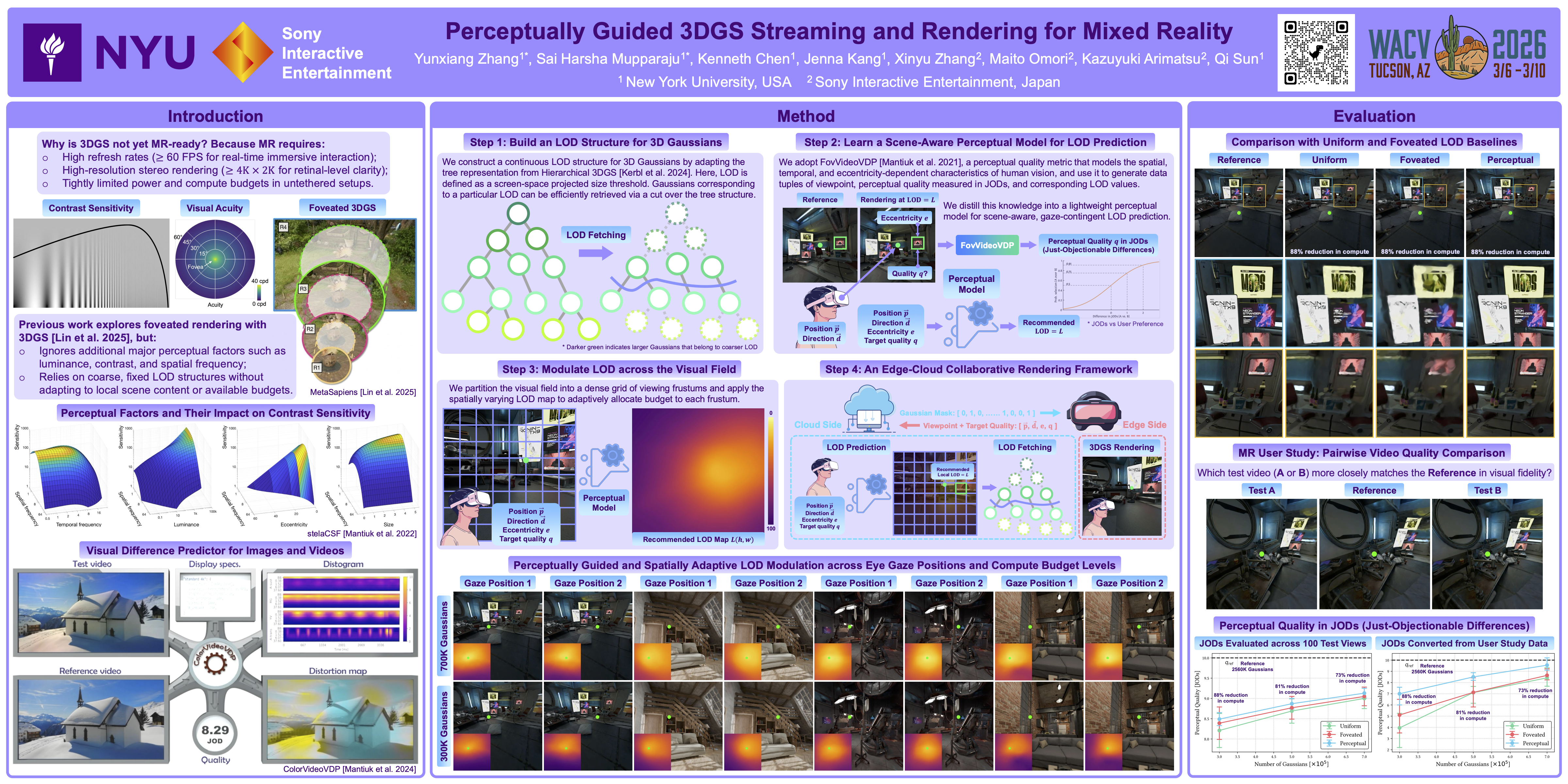
Recent breakthroughs in radiance fields, particularly 3D Gaussian Splatting (3DGS), have unlocked real-time, high-fidelity rendering of complex environments, boosting broad applications. However, the stringent requirements of mixed reality (MR), including high refresh rates, high-resolution stereo rendering, and limited computing, remain beyond the reach of current 3DGS methods. Meanwhile, the wide field-of-view design of MR displays, which mimics natural human vision, offers a unique opportunity to exploit the limitations of the human visual system to reduce computation overhead without compromising perceived rendering quality.To this end, we propose a perception-guided, continuous level-of-detail (LOD) framework for 3DGS that maximizes perceived quality under given compute resources. We distill a visual quality metric, which encodes the spatial, temporal, and peripheral characteristics of human visual perception, into a lightweight, gaze-contingent model that predicts and adaptively modulates the LOD across the user's visual field based on each region's contributions to perceptual quality. This resource-optimized modulation, guided by both scene content and user gaze behavior, enables significant runtime acceleration with minimal loss in perceived visual quality. To support low-power, untethered MR setups, we introduce an edge-cloud rendering framework that partially offloads computation to the cloud, further reducing overhead on the edge device. Objective metrics and MR user study evidence that, compared to vanilla and foveated LOD baselines, our method achieves superior trade-offs between computational efficiency and perceptual quality.