
PrevMatch: Revisiting and Maximizing Temporal Knowledge in Semi-Supervised Semantic Segmentation
Abstract
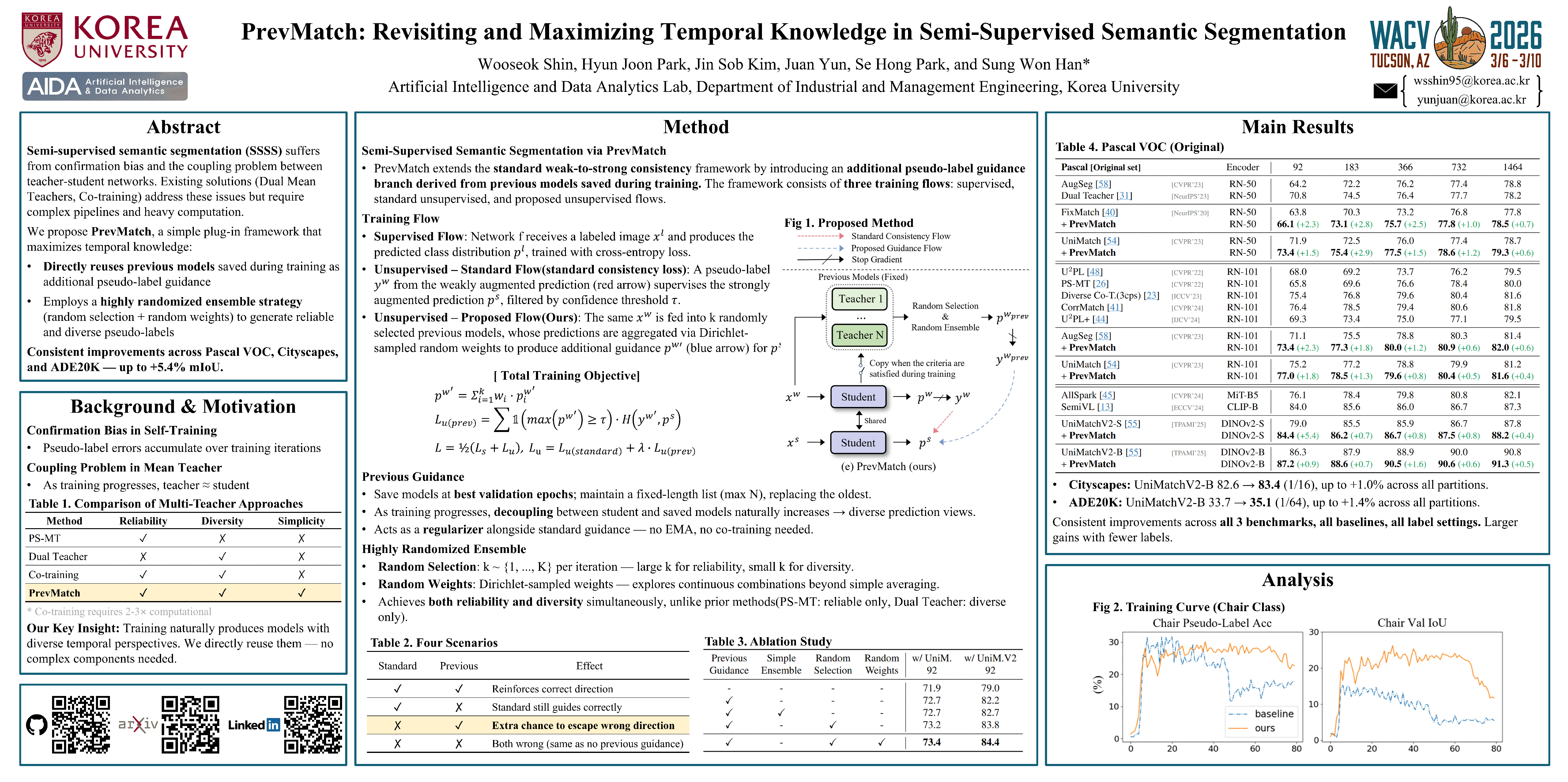
In semi-supervised semantic segmentation, the Mean Teacher- and co-training-based approaches are employed to mitigate confirmation bias and coupling problems. However, despite their high performance, these approaches frequently involve complex training pipelines and a substantial computational burden, limiting the scalability and compatibility of these methods. In this paper, we propose a PrevMatch framework that effectively mitigates the aforementioned limitations by maximizing the utilization of the temporal knowledge obtained during the training process. The PrevMatch framework relies on two core strategies: (1) we reconsider the use of temporal knowledge and thus directly utilize previous models obtained during training to generate additional pseudo-label guidance, referred to as previous guidance. (2) we design a highly randomized ensemble strategy to maximize the effectiveness of the previous guidance. PrevMatch, a simple yet effective plug-in method, can be seamlessly integrated into existing semi-supervised learning frameworks with minimal computational overhead. Experimental results on three benchmark semantic segmentation datasets show that incorporating PrevMatch into existing methods significantly improves their performance. Furthermore, our analysis indicates that PrevMatch facilitates stable optimization during training, resulting in improved generalization performance.