
Self-Supervised Compression and Artifact Correction for Streaming Underwater Imaging Sonar
Rongsheng Qian ⋅ Chi Xu ⋅ Xiaoqiang Ma ⋅ Hao Fang ⋅ Yili Jin ⋅ William Atlas ⋅ Jiangchuan Liu
Abstract
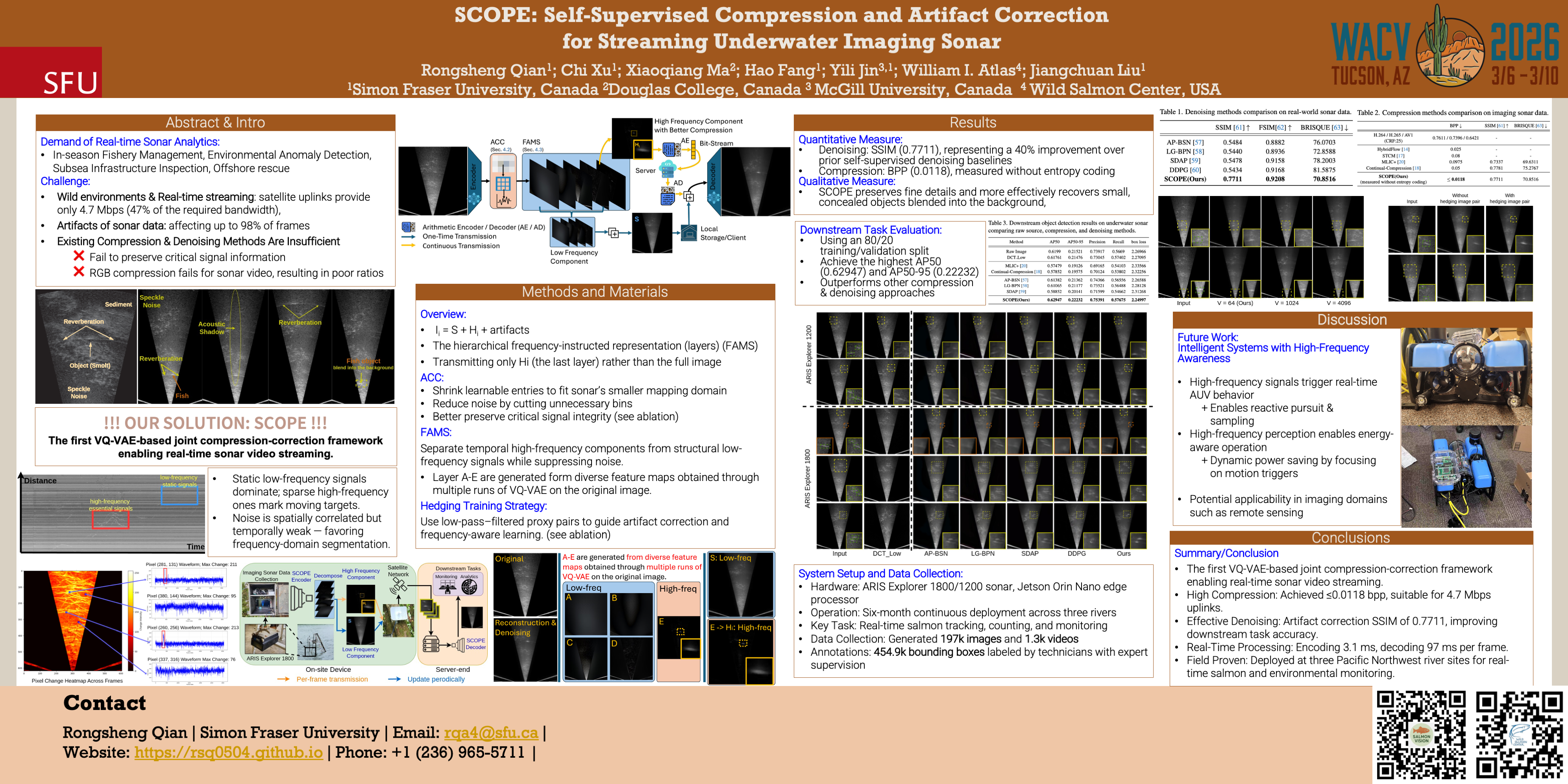
The growing affordability of sonar devices, along with expanded 5G and satellite access, has accelerated imaging sonar deployment in remote, real-time scenarios. Common applications include offshore rescue, disaster warnings, and in-season fisheries. Real-time sonar streaming and analytics in such wild environments face challenges from limited infrastructure, network dynamics, and signal distortion. Existing methods also struggle with low data quality and complex, sonar-specific artifacts. To address these issues, we develop SCOPE, a self-supervised framework for joint compression and artifact correction of sonar streams. It integrates (1) Adaptive Codebook Compression (ACC) for stable latent representations of sonar data, (2) Frequency-Aware Multiscale Segmentation (FAMS) to decompose signals into high-frequency temporal components and low-frequency structural signals while suppressing artifacts, and (3) a hedging training strategy that improves frequency sensitivity and further reduces artifacts.SCOPE requires no clean ground truth and adapts to streaming conditions. Evaluated on real-world Adaptive Resolution Imaging Sonar (ARIS) data, it achieved 0.77 SSIM, 40\% higher than prior work, and compressed to $\leq0.0118$ bits per pixel. Experiments showed SCOPE reduced bandwidth by over 50\% while improving downstream tasks. With 3.1 ms encoding and 97 ms decoding, SCOPE enables real-time processing and has been deployed in three Pacific Northwest rivers for salmon and environmental monitoring, enabling practical, quality sonar streaming in the wild.
Chat is not available.
Successful Page Load