
False Alarm Rectification for Early Smoke Segmentation
Abstract
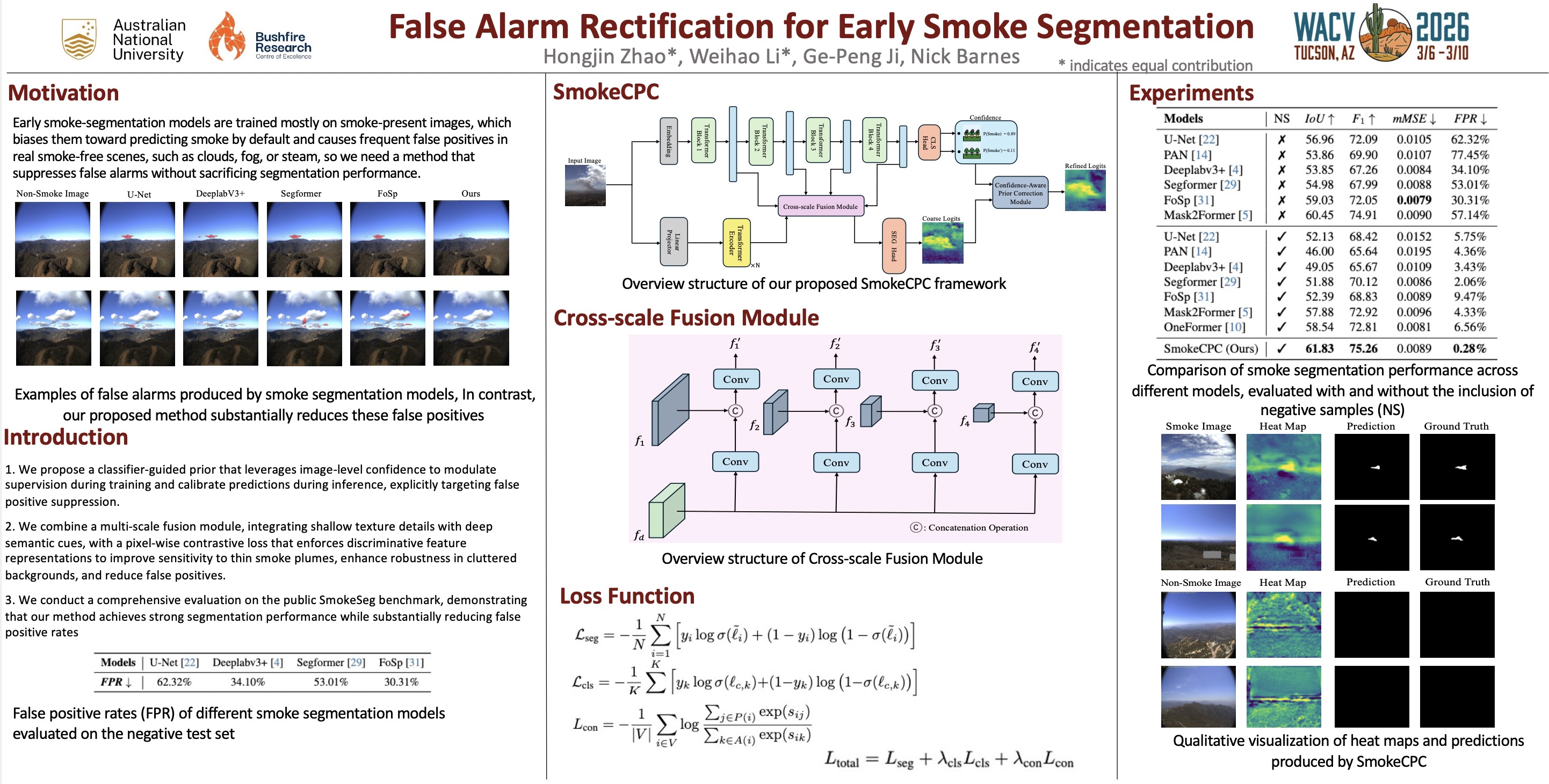
Early smoke segmentation plays a critical role in forest protection and industrial safety. With the increasing deployment of fixed cameras and drones, vision-based smoke detection has become widely adopted. However, in open environments, smoke is easily confused with visually similar phenomena such as clouds, fog, and water vapor, leading to frequent false positives. To address this challenge, we propose a method that suppresses false alarms in pixel-level smoke segmentation while preserving overall detection performance. The core idea is to leverage the confidence of an image-level smoke classifier as a prior to guide both training and inference of the segmentation model. High-confidence samples receive stronger supervision to enhance discriminative capability, whereas low-confidence samples are down-weighted to mitigate noise propagation. In addition, we design a multi-scale feature fusion module that integrates texture and semantic cues from different layers, improving robustness to thin plumes and complex backgrounds. We further introduce a contrastive loss that encourages intra-class compactness and inter-class separability in feature space. Overall, our method reduce the false positive rate without sacrificing segmentation quality. Experiments on the SmokeSeg dataset demonstrate the effectiveness of our approach, achieving an IoU of 61.83\% and an FPR of only 0.28\%. Our code will be released publicly.