
GeoHSAF: Geometric Hippocampus Shape Analysis Framework for Longitudinal Alzheimer's Disease Classification
Abstract
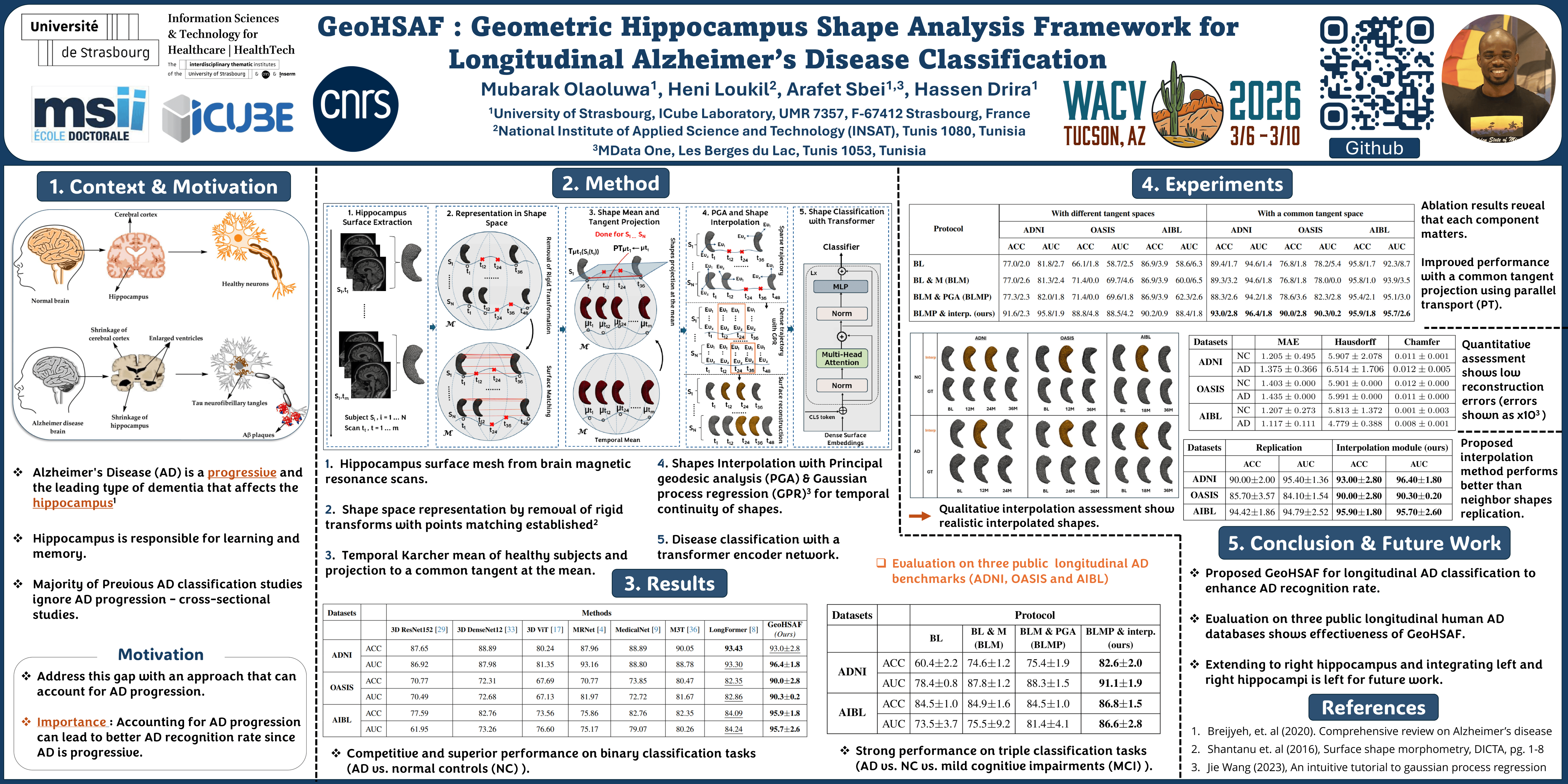
Alzheimer’s disease (AD) is the most common form of dementia and a progressive, irreversible brain disorder that affects millions worldwide. The majority of existing research on AD classification relies on cross-sectional brain magnetic resonance imaging studies, which consider information from a single time point and fail to account for the progressive nature of AD. Longitudinal analysis, however, is crucial for capturing AD evolution and enabling more accurate diagnosis. To address this gap, we propose \textbf{GeoHSAF}, a novel hippocampus-based geometric learning framework for longitudinal AD classification. To overcome the challenge of missing or inconsistent hippocampal shapes across subjects and time points, our framework includes an interpolation module that predicts intermediate shapes, ensuring temporal continuity. We evaluate the effectiveness of GeoHSAF on three public longitudinal AD datasets: ADNI, OASIS, and AIBL, and benchmark its performance against existing approaches. GeoHSAF achieves new state-of-the-art results on binary classification tasks (AD vs. Normal Controls (NC)), while also demonstrating strong performance on more challenging triple-class classification tasks (AD vs. NC vs. Mild Cognitive Impairment (MCI)). Our work is fully reproducible, and all code is available at: \href{https://github.com/anonymous252573/GeoHSAF}{\textcolor{red}{https://github.com/anonymous252573/GeoHSAF}}