
Perception-Inspired Color Space Design for Photo White Balance Editing
Abstract
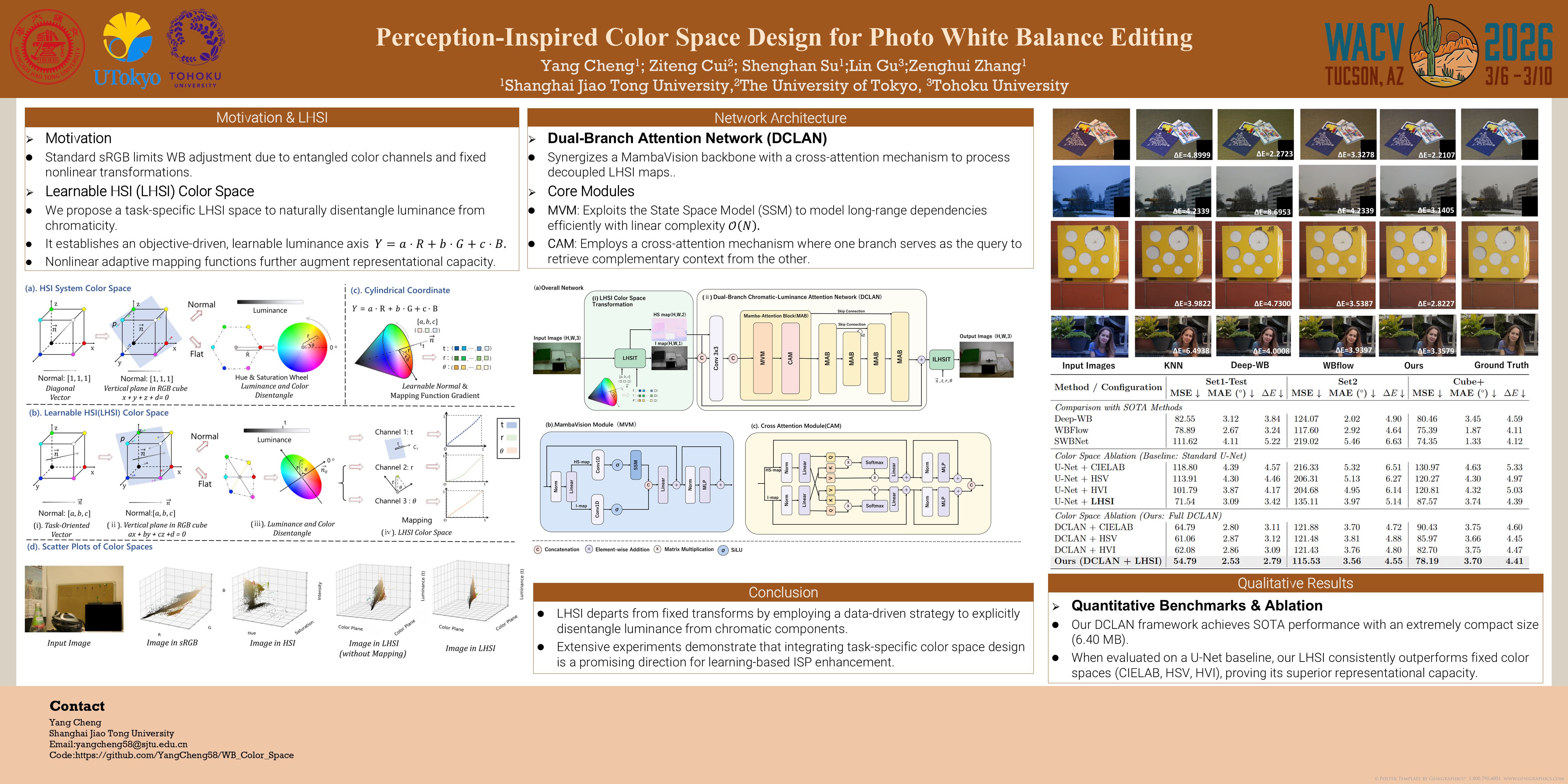
White Balance (WB) is a critical component of the image signal processor (ISP) pipeline, designed to mitigate color casts introduced by diverse illumination conditions and restore the scene's true colors. Currently, sRGB-based WB editing has been widely adopted in cases where color correction errors occur in the absence of an ISP or when the original camera RAW is unavailable. However, its inherent limitations—such as fixed nonlinear transformations and entangled color channels—often hinder its ability to generalize under complex lighting scenarios. To address these challenges, we propose a novel framework for WB editing that leverages a learnable HSI (LHSI) color space. By disentangling luminance from chromatic components, the LHSI representation facilitates more effective modeling of illumination changes. The proposed framework incorporates a specifically designed neural network tailored for the LHSI color space, which optimizes a learnable illumination axis within this adaptive representation, enabling precise and flexible illumination correction. Experimental results on multiple benchmark datasets show that our method achieves remarkable performance, highlighting the importance of adaptive color space design in computational photography and pointing to a promising direction for learning-based WB methods.