
Predicting Task fMRI Contrasts from Resting-State fMRI Using Sparse 3D Convolutions
Ivan Sviridov ⋅ Maria Boyko ⋅ Maksim Sharaev
Abstract
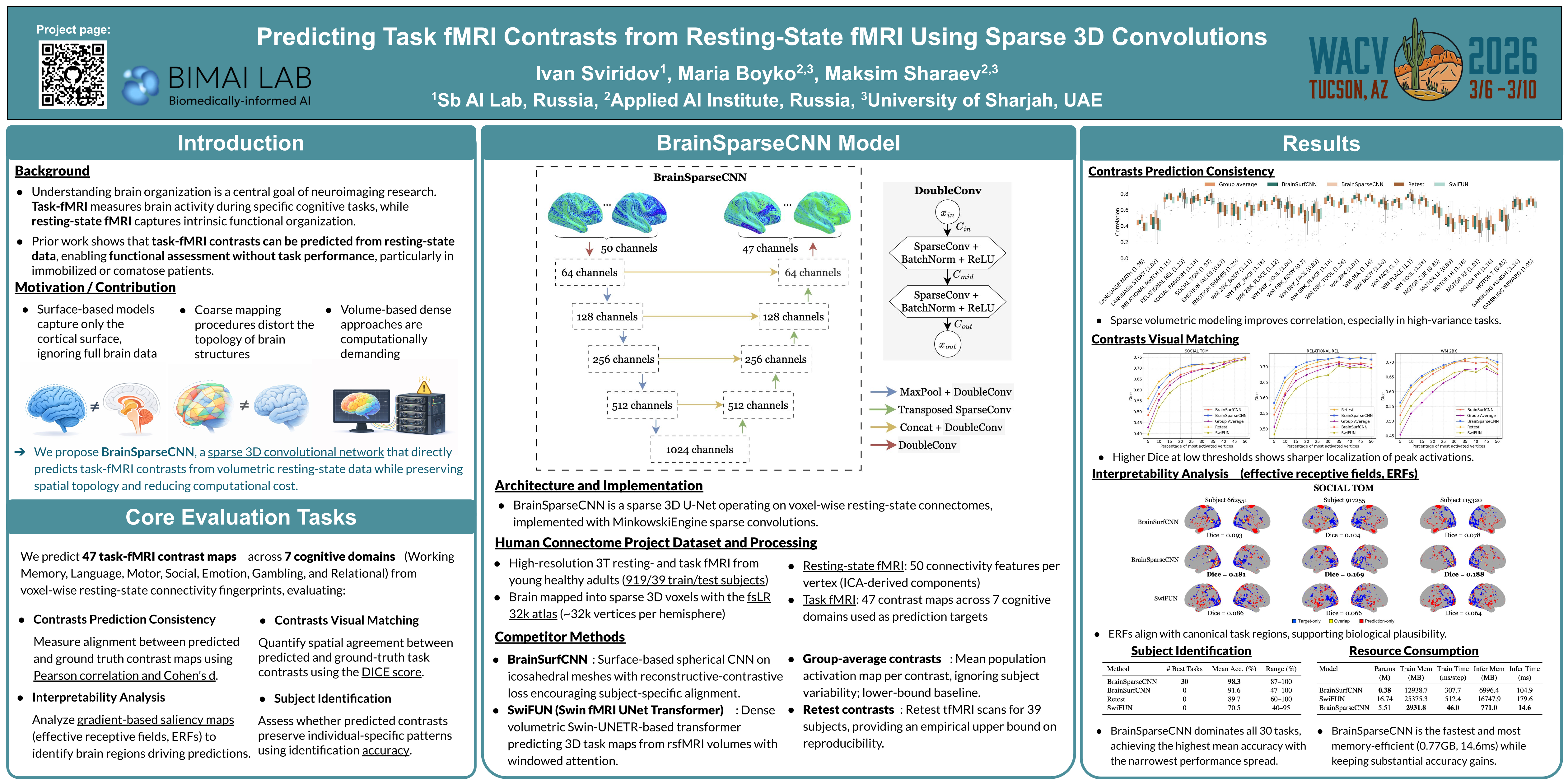
Understanding how specific cognitive tasks activate different brain regions is crucial for neuroscience and clinical applications. Functional Magnetic Resonance Imaging (fMRI) provides valuable insights into these activations. However, acquiring task-based fMRI (tfMRI) is costly, time-consuming, and particularly challenging for individuals with cognitive or motor impairments, such as patients in a coma or those who have suffered a stroke and are unable to perform tasks. Resting-state fMRI (rsfMRI), which is more widely available and does not require task compliance, can be utilized to derive task-related activations. In this work, we propose **BrainSparseCNN**, a sparse 3D convolutional neural network that leverages the unique spatial structure of the brain to predict tfMRI contrasts from rsfMRI. Our approach efficiently processes high-dimensional neuroimaging data while preserving critical spatial relationships. We demonstrate that BrainSparseCNN achieves up to 7\% higher Pearson correlation than prior state-of-the-art, with statistically significant gains ($p < 0.01$) across all tasks. It further improves spatial alignment (Dice score), subject identification accuracy, and saliency interpretability, outperforming surface-based and volumetric baselines. BrainSparseCNN establishes a robust, interpretable, and scalable framework for inferring individual functional activation maps from resting-state data.
Chat is not available.
Successful Page Load