
Reviving Unsupervised Optical Flow: Concept Reevaluation, Multi-Scale Advances and Full Open-Source Release
Abstract
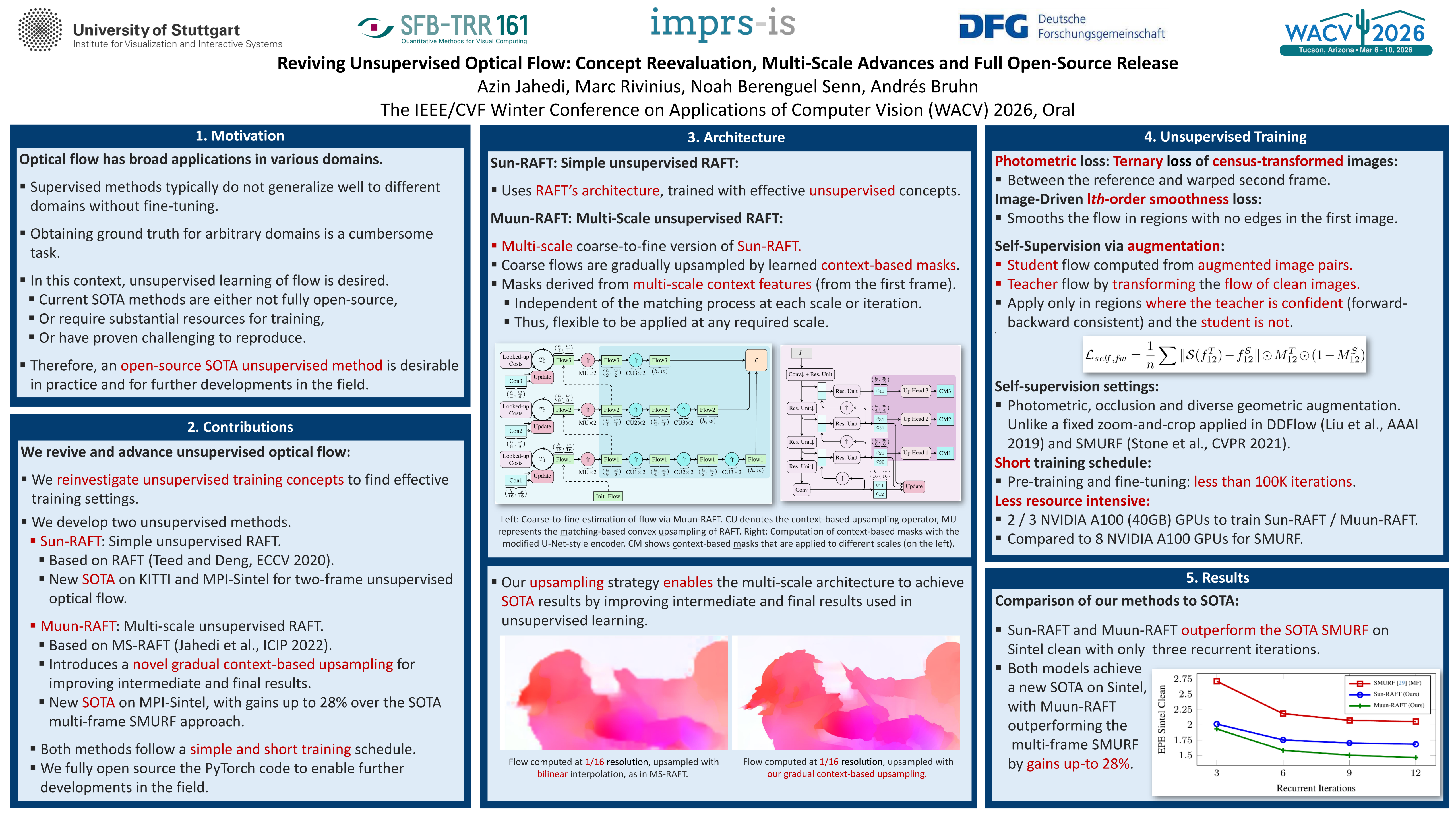
Unsupervised optical flow methods have become more popular in the last decade, enabling the training of models across domains without ground truth data. Although RAFT and its successors have achieved significant success in the supervised settings, many unsupervised approaches continue to use older backbones such as PWC-Net. One reason for this architectural stagnation is that the current RAFT-based SOTA approach has proven challenging for the community to reproduce. In this paper, we revive and advance unsupervised optical flow: First, we introduce Sun-RAFT: a simple unsupervised RAFT. Second, building on Sun-RAFT, we present Muun-RAFT: a novel multi-scale unsupervised RAFT, where we propose a gradual context-based upsampling to refine the flow, further improving both accuracy and preservation of details. Third, we reexamine previously advised unsupervised strategies to identify effective training settings. In terms of results, both our methods demonstrate strong generalization capabilities and set a new SOTA for unsupervised two-frame approaches on MPI-Sintel, with Muun-RAFT surpassing even the current multi-frame SOTA by up to 28%. Finally, we open-source our PyTorch code, enabling further developments in the field: https://cv-stuttgart.github.io/Reviving-Unsupervised-OpticalFlow.