
Fetal and Neonatal Cortical Surface Reconstruction with Anatomical Normal-guidance and Perceptual Enhancements
Abstract
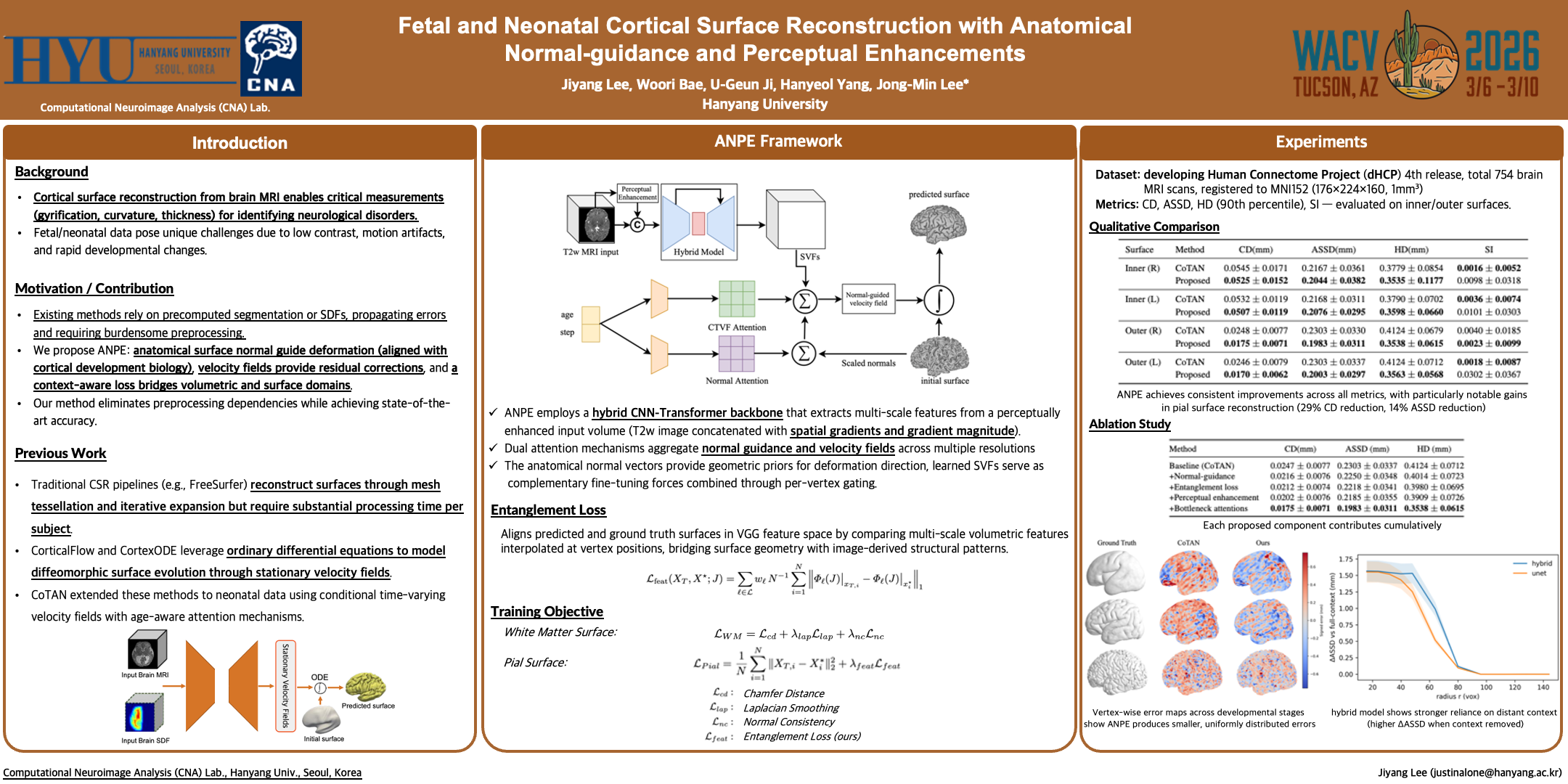
Accurate reconstruction of cortical surfaces from fetal and neonatal brain MRI plays a fundamental role in neuroscience research and clinical applications. Despite recent advances in deep learning-based approaches, accurate fetal and neonatal surface reconstruction remains challenging due to low tissue contrast, narrow sulci, and complex folding patterns. We present ANPE (Anatomical Normal-guidance with Perceptual Enhancements), a simple yet effective framework that enhances cortical surface reconstruction networks through three key aspects: Our method enforces anatomically plausible deformations by adaptively integrating normal vectors with velocity vectors to simultaneously capture global structure and fine-grained details, significantly improving geometric coherence. Furthermore, we amplify structural transitions and tissue boundaries without requiring explicit segmentation or signed distance functions to eliminate the dependency on additional processing steps, making our method more efficient and widely applicable. Finally, we utilize a context-aware loss function that transcends traditional point-wise losses by integrating a pre-trained feature extractor to captures hierarchical contextual and structural similarities, blending surface-based and image-based features to ensure anatomically meaningful reconstructions. Our simple yet efficient framework is shown to be an efficient, more accurate, and biologically informed approach, presents a new baseline to the fetal and neonatal cortical surface reconstruction.