
AUTOCORRELATION-BASED FIDUCIAL MARKERS FOR TRACEABILITY
Abstract
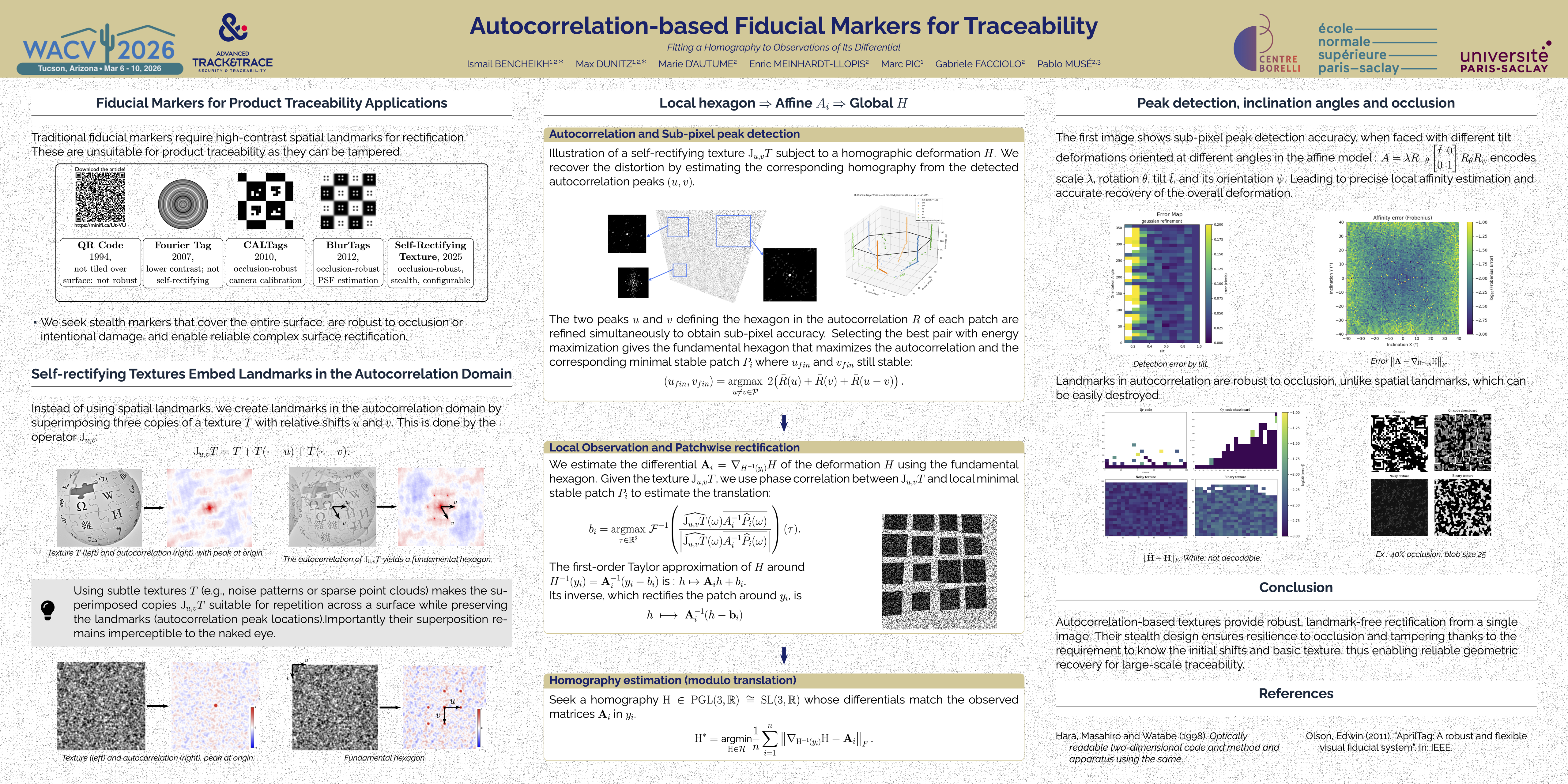
Classical approaches to the rectification of a single image of a product, without stereo correspondences, require spatial landmarks. These landmarks are often conspicuous as they are generally built from high-contrast elementary shapes that can be detected with simple algorithms. To rectify complex deformations or ensure the robustness of homography rectification to landmark occlusion or tampering, one can use chessboard patterns of markers with elements that break quadrilateral symmetry, such as the three eyes of a QR code. However, these marker boards are even more conspicuous than a single marker. Motivated by traceability applications, which require stealth and robust fiducial markers that can rectify complex deformations, we introduce self-rectifying textures. These stealth textures place fiducial markers in the image autocorrelation. In this way, arbitrary crops of the texture can be rectified using only these spatially invariant statistical properties. Affine transformations of an image correspond to linear transformations of the autocorrelation, without phase component. Exploiting this fact, self-rectifying textures enable local estimation of the linear component of a planar deformation by identifying landmarks in the autocorrelation image, such as peaks, whose location in the untransformed texture is known. The translation component can be recovered independently via the phase correlation. A rectifying map, modulo translations, can also be fit directly to local observations of the differential of the deformation, without access to the rectified texture or need for phase correlation. Self-rectifying textures can be used for communication, watermarking, authentication, surface identification, calibration, and geometry processing.