
Learning Subglacial Bed Topography from Sparse Radar with Physics-Guided Residuals
Bayu Tama ⋅ Jianwu Wang ⋅ Vandana Janeja ⋅ Mostafa Cham
Abstract
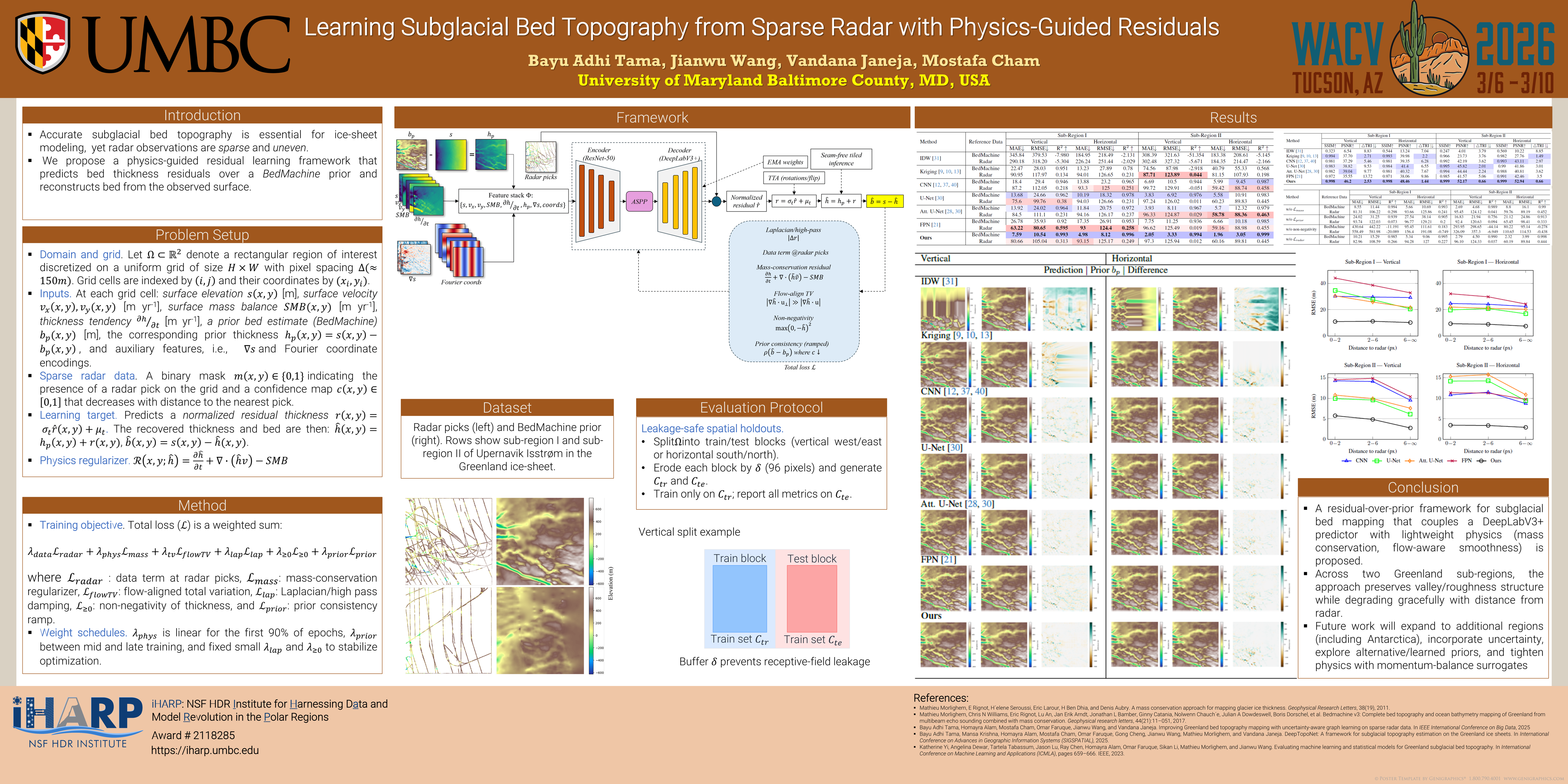
Accurate subglacial bed topography is essential for ice-sheet modeling, yet radar observations are sparse and uneven. We propose a physics-guided residual learning framework that predicts bed \emph{thickness residuals} over a BedMachine prior and reconstructs bed from the observed surface. A DeepLabV3$+$ decoder over a standard encoder (e.g., ResNet-50) is trained with lightweight physics and data terms: multi-scale mass conservation, flow-aligned total variation, Laplacian damping, non-negativity of thickness, a ramped prior-consistency term, and a masked Huber fit to radar picks modulated by a confidence map. To measure real-world generalization, we adopt leakage-safe \emph{block-wise} hold-outs (vertical/horizontal) with safety buffers and report metrics only on held-out cores. Across two Greenland sub-regions, our approach achieves strong test-core accuracy (RMSE $3.05$–$10.54$\,m; $R^2=0.993$–$0.999$) and high structural fidelity (SSIM $\ge 0.998$, PSNR up to $52.9$\,dB), outperforming U-Net, Attention U-Net, FPN, and a plain CNN. The residual-over-prior design, combined with physics, yields spatially coherent, physically plausible beds suitable for operational mapping under domain shift.
Chat is not available.
Successful Page Load