
Real-Time Tracking of Flexible Markers in Low-Contrast Fluoroscopy Using a Deep Neural Network Trained Solely on Synthetic Data
Tomoki Uchiyama ⋅ Yukinobu Sakata ⋅ Ryusuke Hirai ⋅ Hitoshi Ishikawa ⋅ Shinichiro Mori
Abstract
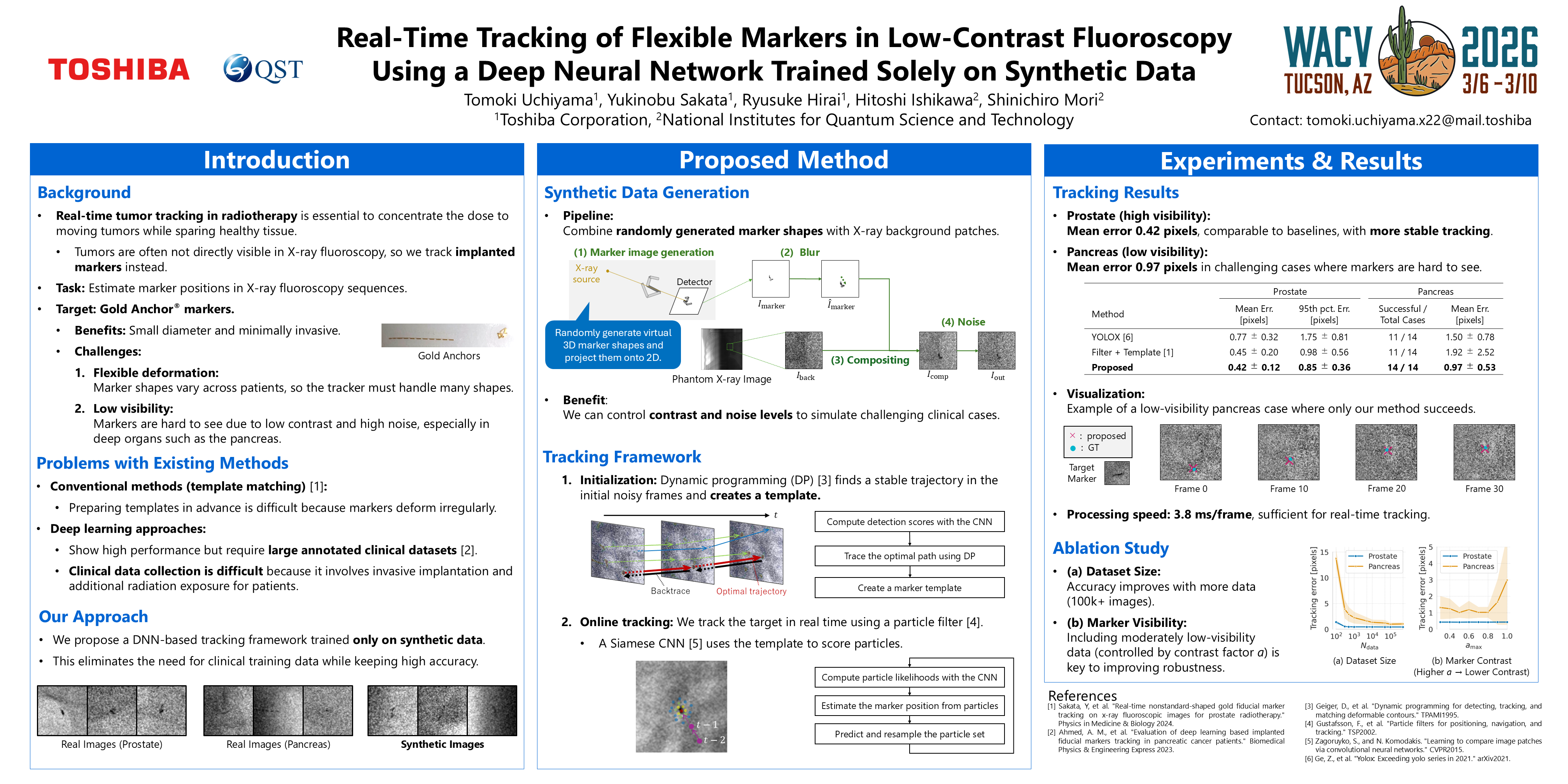
In radiation therapy, fiducial markers implanted in a patient's body are tracked using X-ray fluoroscopy to estimate tumor positions.However, flexible markers, such as Gold Anchor$^{\textregistered}$ (Naslund Medical AB, Sweden), deform within the body, making conventional template matching challenging.While deep learning offers a promising solution, the extensive collection and annotation of clinical data required for training poses a significant barrier to adoption.To address this, we propose a tracking framework that utilizes a lightweight Siamese CNN trained exclusively on synthetic fluoroscopy images.Our method generates synthetic data simulating diverse marker deformations under low-contrast and high-noise conditions, employs dynamic programming for stable initial detection, and performs real-time tracking with a particle filter.In evaluations using clinical data, our method achieves a tracking accuracy of 0.42 ± 0.12 pixels for prostate cancer cases and 0.97 ± 0.53 pixels for pancreatic cancer cases.This significantly outperforms conventional methods, particularly in challenging low-contrast pancreatic cancer cases.With TensorRT optimization, the framework achieves a processing speed of 3.8 ms/frame.This work presents a practical solution for high-accuracy tracking, reducing data collection costs and facilitating the use of deep learning in clinical applications.
Chat is not available.
Successful Page Load