
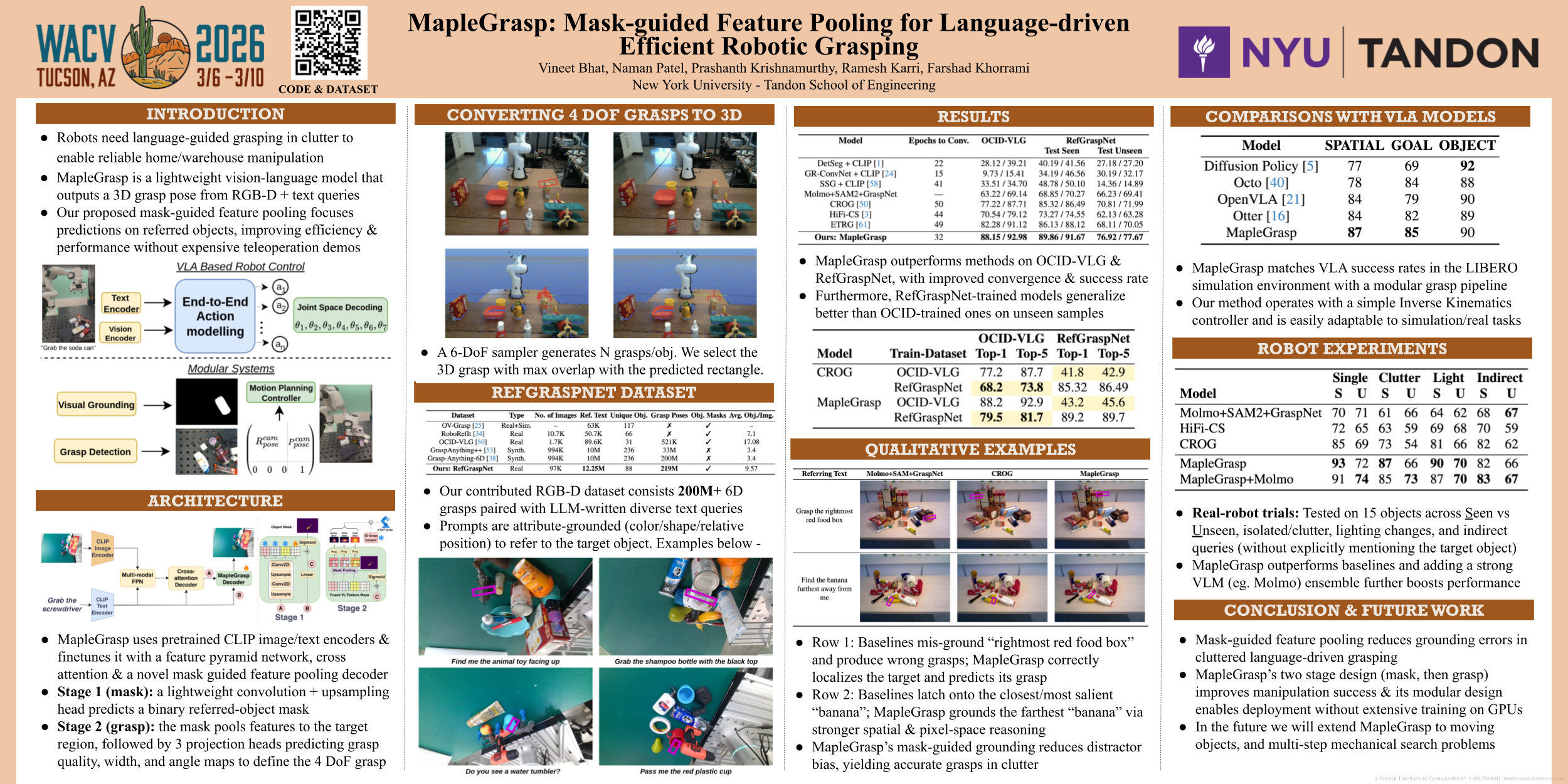
MapleGrasp: Mask-guided Feature Pooling for Language-driven Efficient Robotic Grasping
Abstract
Robotic manipulation of unseen objects via natural language commands remains challenging. Language driven robotic grasping (LDRG) predicts stable grasp poses from natural language queries and RGB-D images. We propose MapleGrasp, a novel framework that leverages mask-guided feature pooling for efficient vision-language driven grasping. Our two-stage training first predicts segmentation masks from CLIP-based vision-language features. The second stage pools features within these masks to generate pixel-level grasp predictions, improving efficiency, and reducing computation. Incorporating mask pooling results in a 7% improvement over prior approaches on the OCID-VLG benchmark. Furthermore, we introduce RefGraspNet, an open-source dataset eight times larger than existing alternatives, significantly enhancing model generalization for open-vocabulary grasping. MapleGrasp scores a strong grasping accuracy of 89\% when compared with competing methods in the RefGraspNet benchmark. Our method achieves comparable performance to larger Vision-Language-Action models on the LIBERO benchmark, and shows significantly better generalization to unseen tasks. Real-world experiments on a Franka arm demonstrate 73% success rate with unseen objects, surpassing competitive baselines by 11%. Code will be released after publication.